2026-10-20 東北大学
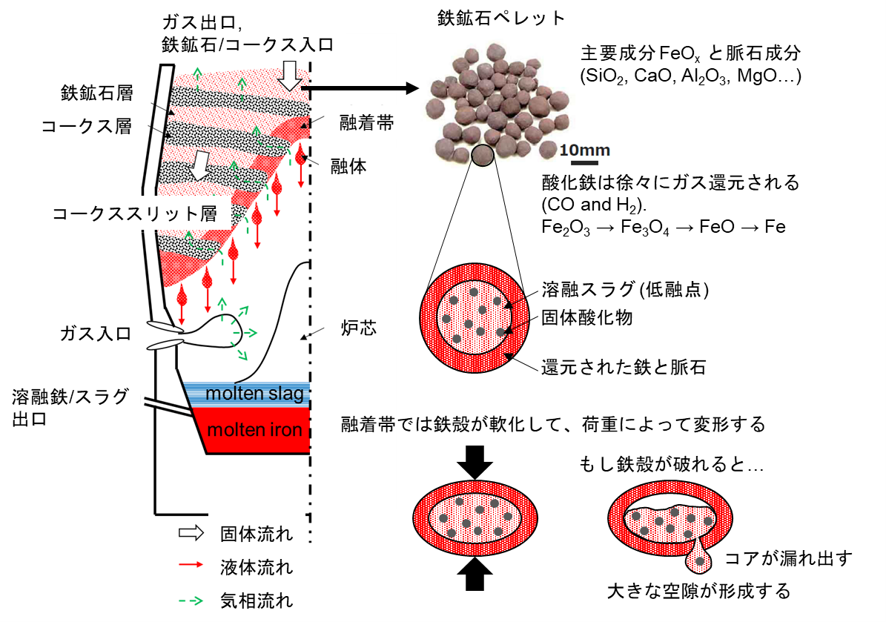
図1.高炉内の融着帯と鉄鉱石ペレットの変形過程の模式図。
鉄鉱石ペレットは還元されながら軟化・変形し、最終的に溶融・滴下する。
<関連情報>
- https://www.tohoku.ac.jp/japanese/2026/10/press20261020-02-xct.html
- https://www.nature.com/articles/s41598-026-74732-9
持続可能な鉄鉱石還元・軟化・溶解のためのマルチフィジックスフレームワーク:高エネルギーX線コンピュータ断層撮影と移動粒子流体動力学 Multiphysics framework for sustainable iron ore reduction–softening–melting: high-energy X-ray computed tomography and moving particle hydrodynamics
Shungo Natsui, Allert Adema, Jan van der Stel, Yongxiang Yang, Kaede Kano, Masahiro Kondo, Miho Hayasaka, Akihisa Ito, Takayuki Iwama & Hiroshi Nogami
Scientific Reports Published:16 October 2026
DOI:https://doi.org/10.1038/s41598-026-74732-9 Early provide
Abstract
The steelmaking industry is one of the most difficult industrial sectors to decarbonise, with blast furnaces projected to play a dominant role in global iron production during this energy transition period. Iron ore behaviour remains largely unpredictable, given the uncertainty in the softening, deformation, and melting of iron-ore pellets in the cohesive zone, where small changes in gas permeability can significantly reduce furnace stability. Herein, we combine high-energy X-ray computed tomography, micro-chemical analysis, and moving particle hydrodynamics to link the internal transformation of reduced pellets with the mechanical collapse of a packed bed. Interrupted reduction–softening–melting experiments showed a progressive transition from a load-bearing metallic-iron shell at 1300 °C, to iron–slag coexistence and oxide enrichment in the core at 1400 °C, and finally to melting and dripping at 1550 °C. Three-dimensional tomography results quantified how the pellet-rich layer densifies and narrows, while particle simulations reproduced its displacement and collapse using a yield-stress formulation constrained by experimental data. This inverse calibration helped translate the observed deformation into a temperature-dependent shell-strength law. Our multiphysics framework converts tomographic images from static descriptors into predictive inputs for multi-scale furnace models, thereby offering a method to evaluate raw materials and operational strategies for low-carbon ironmaking.