2026-10-20 東北大学
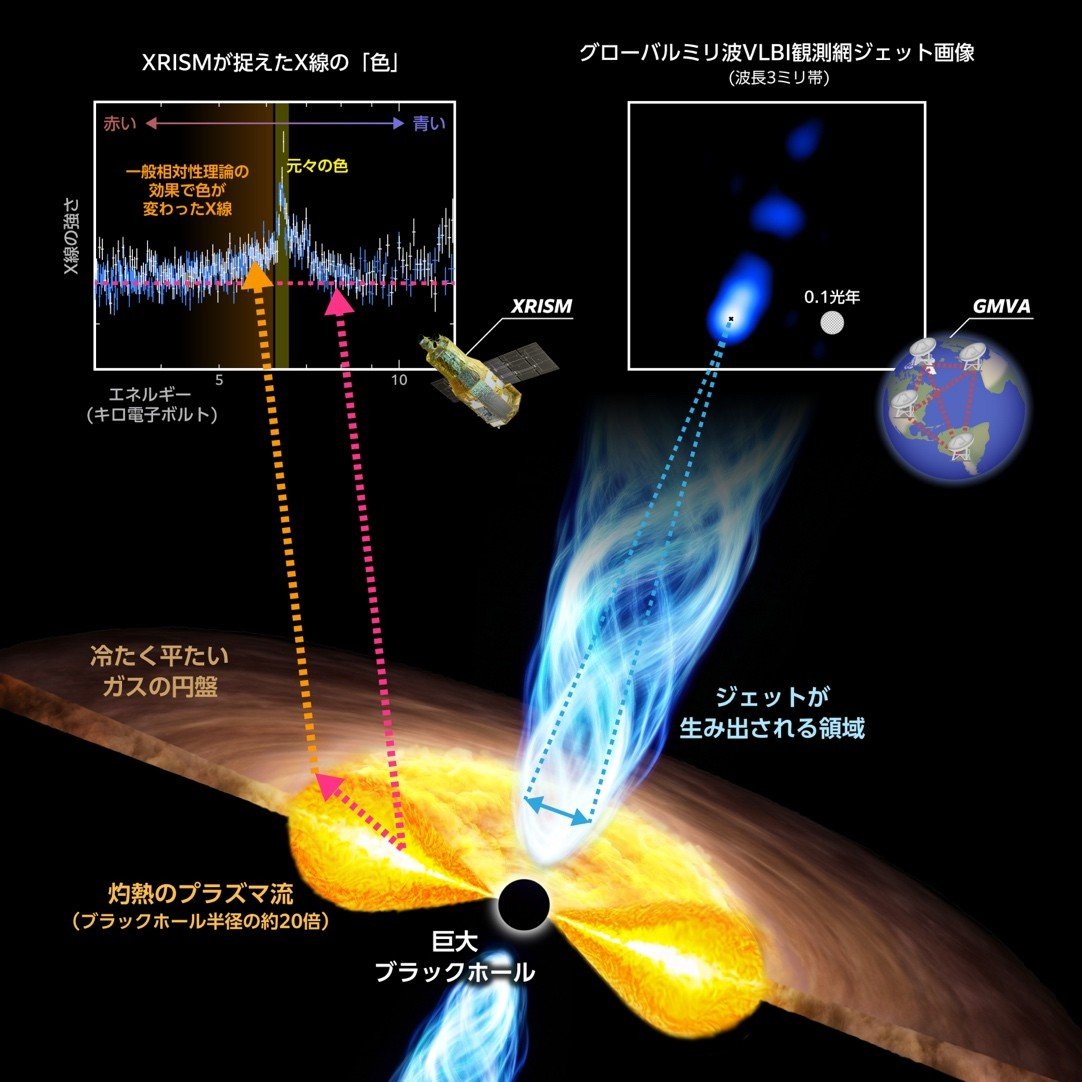
図1.
<関連情報>
- https://www.tohoku.ac.jp/japanese/2026/10/item20261020-03-jet.html
- https://iopscience.iop.org/article/10.3847/2041-8213/aeaa2c
円盤の切断が、高降着超大質量ブラックホールの相対論的ジェット噴出を引き起こす Disk Truncation Triggers Relativistic Jet Launching of a Highly Accreting Supermassive Black Hole
Hirofumi Noda, Kazuhiro Hada, Hiroto Maruyama, Taishu Kayanoki, Kenji Toma, Taiki Kawamuro, Yoshiyuki Inoue, Tomohisa Kawashima, Soyeon Yeo, Ilje Cho,…
The Astrophysical Journal Letters Published: 2026 October 19
DOI:10.3847/2041-8213/aeaa2c
Abstract
Relativistic jets are among the most energetic phenomena in the Universe and influence galaxy evolution through energetic feedback, yet the physical connection between accretion flows and jet launching remains unresolved. Jet production is widely attributed to the Blandford–Znajek mechanism, which extracts black hole rotational energy via large-scale magnetic fields sustained by an accretion flow. Although this mechanism is observationally well supported for hot, geometrically thick accretion flows, highly accreting environments with strong jets present a paradox, as they are typically dominated by cold, geometrically thin disks incapable of sustaining large-scale magnetic fields. Here, we report coordinated X-ray microcalorimeter spectroscopy achieved by X-ray Imaging and Spectroscopy Mission (XRISM) and millimeter–radio interferometric observations by Global Millimeter Very Long Baseline Interferometry (VLBI) Array (GMVA), Very Long Baseline Array (VLBA), and East Asian VLBI Network (EAVN) of the broad-line radio galaxy 3C 120. High-resolution X-ray spectroscopy reveals a relativistically broadened Fe Kα line, indicating that the cold, geometrically thin disk is truncated at ∼20Rg (Rg is the gravitational radius), with the inner region replaced by a hot, geometrically thick flow. Concurrently, radio imaging indicates that jet profile extrapolation toward the black hole horizon yields a radius comparable to or even narrower than the disk truncation radius. These results demonstrate that, even at high accretion rates, jet launching is linked to a hot inner flow, possibly via the Blandford–Znajek process, providing evidence for a universal disk–jet connection via geometric transition.