2026-09-30 中国科学院(CAS)
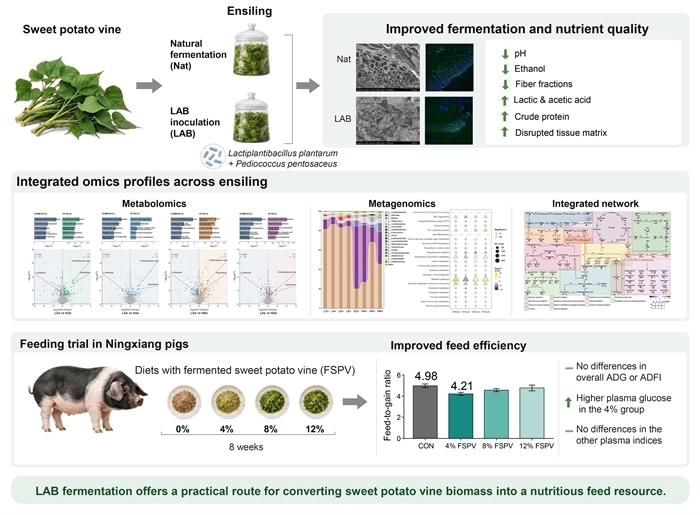
Lactic acid bacteria reshape microbial communities and metabolic processes during sweet potato vine fermentation and support its utilization as a feed resource for Ningxiang pigs. (Image by HU Weidong)
<関連情報>
- https://english.cas.cn/newsroom/research-news/202610/t20261001_1201656.shtml
- https://www.sciencedirect.com/science/article/abs/pii/S1385894726099511
乳酸菌を接種したサツマイモ蔓の発酵によるバイオマス有効利用のマルチオミクス解析 Multi-omics characterization of lactic acid bacteria-inoculated sweet potato vine fermentation for biomass valorization
Weidong Hu, Yexing Feng, Hanyu Hu, Qian Zhu, Jin Zhong, Xiangfeng Kong
Chemical Engineering Journal Available online: 28 September 2026
DOI:https://doi.org/10.1016/j.cej.2026.182488
Highlights
- Inoculation lowered pH and ethanol production throughout sweet potato vine ensiling.
- Microscopy showed greater disruption of the sweet potato vine tissue matrix.
- Multi-omics revealed Lactiplantibacillus succession and metabolic remodeling.
- Overall F/G was lower with 4% FSPV supplementation than the CON (4.21 vs. 4.98).
Abstract
Sweet potato vine (SPV) is a high moisture agricultural byproduct that requires effective preservation before use as feed. This study examined the effects of a mixed Lactiplantibacillus plantarum and Pediococcus pentosaceus inoculant on SPV ensiling. SPV was ensiled naturally or with the inoculant for 2, 4, 6, and 8 weeks. Fermentation quality, nutritional composition, microstructure, shotgun metagenomics, untargeted metabolomics, and associations between microbial taxa and metabolites were analyzed. A feeding trial lasting 8 weeks involved 32 pigs fed diets containing 0%, 4%, 8%, or 12% fermented SPV (FSPV). Compared with natural fermentation, inoculation decreased pH and ethanol throughout ensiling, increased lactic acid at weeks 2 and 6 and crude protein at weeks 4–8, and decreased crude fiber at weeks 6 and 8 of ensiling, with greater tissue disassembly. Metabolomics identified 164, 93, 216, and 73 differential features at weeks 2, 4, 6, and 8, respectively. 3-Dehydroquinic acid and isopyridoxal were consistently higher, whereas l-glutamine was consistently lower. Community composition differed among treatment and time groups (P = 0.001), with a relative abundance profile dominated by Lactiplantibacillus after inoculation. Fifteen COG categories and 20 CAZy families differed between treatments. In pigs, overall F/G differed among diets (P = 0.049), with a lower value at 4% FSPV than CON (4.21 vs. 4.98; P = 0.013). Final body weight, overall ADG, and overall ADFI did not differ among diets. Plasma glucose was higher in the 4% group than in all other groups, whereas other plasma indices did not differ. These findings indicate that LAB fermentation offers a practical route for converting SPV biomass into a usable feed resource.