2026-08-19 合肥物質科学研究院(HFIPS)
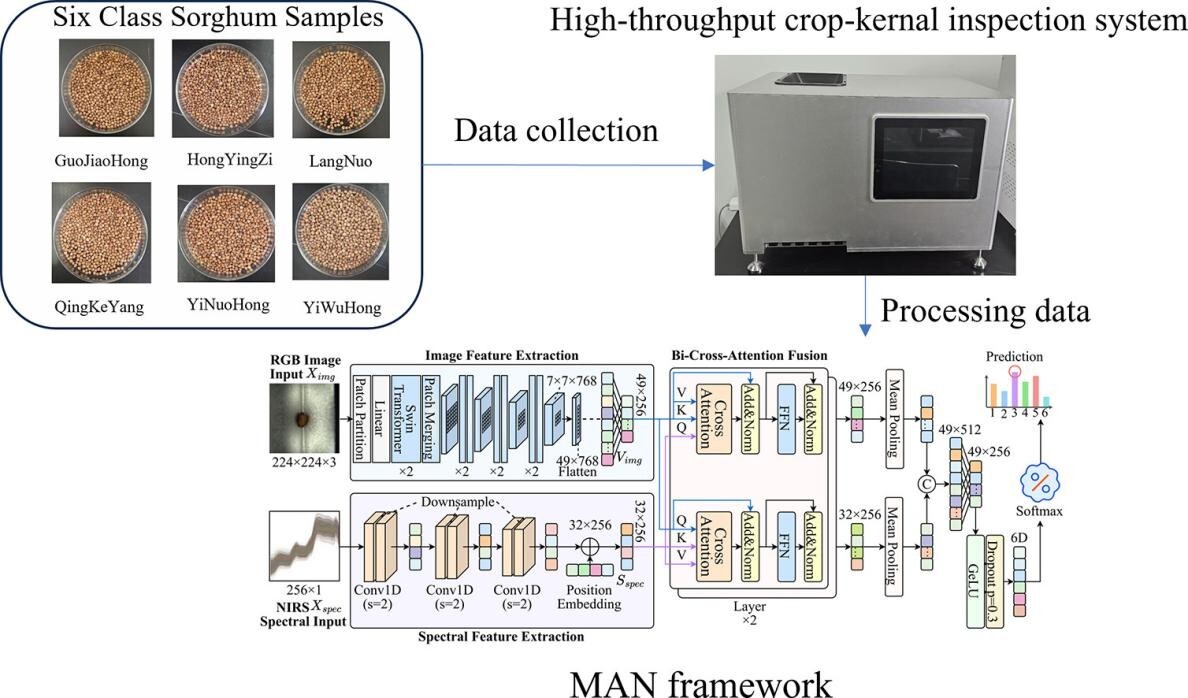
High throughput variety discrimination for single sorghum grains based on Multimodal Attention Network (MAN) (Image by XU Zhuopin)
<関連情報>
- https://english.hf.cas.cn/nr/rn/202608/t20260819_1188614.html
- https://onlinelibrary.wiley.com/doi/abs/10.1002/mop.70697
- https://www.sciencedirect.com/science/article/abs/pii/S1386142526010152
近赤外分光法と決定レベル融合に基づくソルガム穀粒の高スループット品種判別 High-Throughput Variety Discrimination for Sorghum Grains Based on Near-Infrared Spectroscopy and Decision-Level Fusion
Zhuopin Xu, Yan Li, Zan Liu, Anjing Chen, Shihai Jiang, Xiaoqin Wang, Qiang Rao, Xiaoshuai Wan, Yuejin Wu, Qi Wang, Qingliang Zhang, Pengfei Zhang
Maicrowave and Optical Technology Letters Published:10 July 2026
DOI:https://doi.org/10.1002/mop.70697
ABSTRACT
As the primary raw material for Chinese Baijiu, the variety of sorghum grains critically influences the taste, flavor, and yield of the Baijiu. This study introduces a method based on near-infrared spectroscopy (NIRS) and decision-level fusion (DLF) for high-throughput, nondestructive, and precise discrimination of sorghum grain varieties. The method leverages the relationship between key sorghum components (e.g., tannin content and amylopectin content) and variety categories. By fusing the spectral prediction results from NIR quantitative models for single-grain tannin content, single-grain amylopectin content, and a basic qualitative model for single-grain variety category, a DLF model with enhanced variety discrimination performance can be developed for high-throughput detection. This method was validated using more than 20 000 sorghum grains from 82 different sources. Spectral acquisition and analysis were performed on a self-developed high-throughput single-grain detection device. Results show that, under various machine learning algorithm optimizations, the proposed DLF model improved prediction accuracy by 0.09%–7.82% and prediction F1-score by 0.09%–9.77% compared to the basic sorghum variety discrimination model. This demonstrates the effectiveness of the proposed method and its potential in the quality control of raw materials for Baijiu production.
ソルガム種子の品種識別のための高スループットかつ非破壊的なマルチモーダル深層融合 High-throughput and nondestructive multimodal deep fusion for variety identification of sorghum kernels
Zibo Guo, Zhuopin Xu, Pengfei Zhang, Anjing Chen, Xiaoqin Wang, Qiang Rao, Xiaoshuai Wan, Qingliang Zhang, Qi Wang
Spectrochimica Acta Part A: Molecular and Biomolecular Spectroscopy Available online: 13 July 2026
DOI:https://doi.org/10.1016/j.saa.2026.128444
Highlights
- A paired NIRS–RGB dataset of 14,400 sorghum kernels was built.
- MAN enables two-way attention between spectra and images.
- The proposed model achieved 98.88% accuracy for six varieties.
- Three-day external validation achieved 97.58% accuracy.
- Cross-attention improved high-throughput sorghum identification.
Abstract
Accurate, nondestructive, and high-throughput identification of sorghum varieties is essential for intelligent agriculture and industrial quality control. However, single-modality approaches based on either RGB imaging or near-infrared spectroscopy (NIRS) often suffer from limited robustness when inter-variety differences are subtle. In this study, a synchronized NIRS–RGB multimodal dataset was established for six representative sorghum varieties, including 14,400 paired kernel samples (2400 samples per variety). Each sample contained a NIR spectrum covering 901.467–1706.76 nm with 256 variables and a high-resolution RGB image. An end-to-end Multi-modal Attention Network (MAN) was proposed to perform deep feature fusion through bi-directional cross-attention, enabling adaptive interactions between spectral physicochemical signatures and visual appearance cues. Under an 8:2 split with five-fold cross-validation on the training set, MAN with a Swin Transformer visual branch achieved an accuracy of 0.9888 and an F1-score of 0.9889, outperforming the best NIRS-only baseline by 8.40 percentage points in accuracy and the best RGB-only baseline by 6.09 percentage points. Ablation results showed that cross-attention was the major contributor to performance improvement, while bi-directional interaction and spectral SE attention further enhanced discriminability. Furthermore, independent three-day replicate validation achieved a pooled accuracy of 0.9758 and an F1-score of 0.9755, indicating good generalizability across acquisition days. The results demonstrate that the proposed MAN effectively exploits complementary NIRS and RGB information, providing a robust and nondestructive solution for fine-grained sorghum variety identification in high-throughput inspection scenarios.