
キャラクター動作のニュアンスを連続制御する生成AIー感情・勢い・誇張の度合いを中間データなしでコントロールー

2026-09-04 東京科学大学

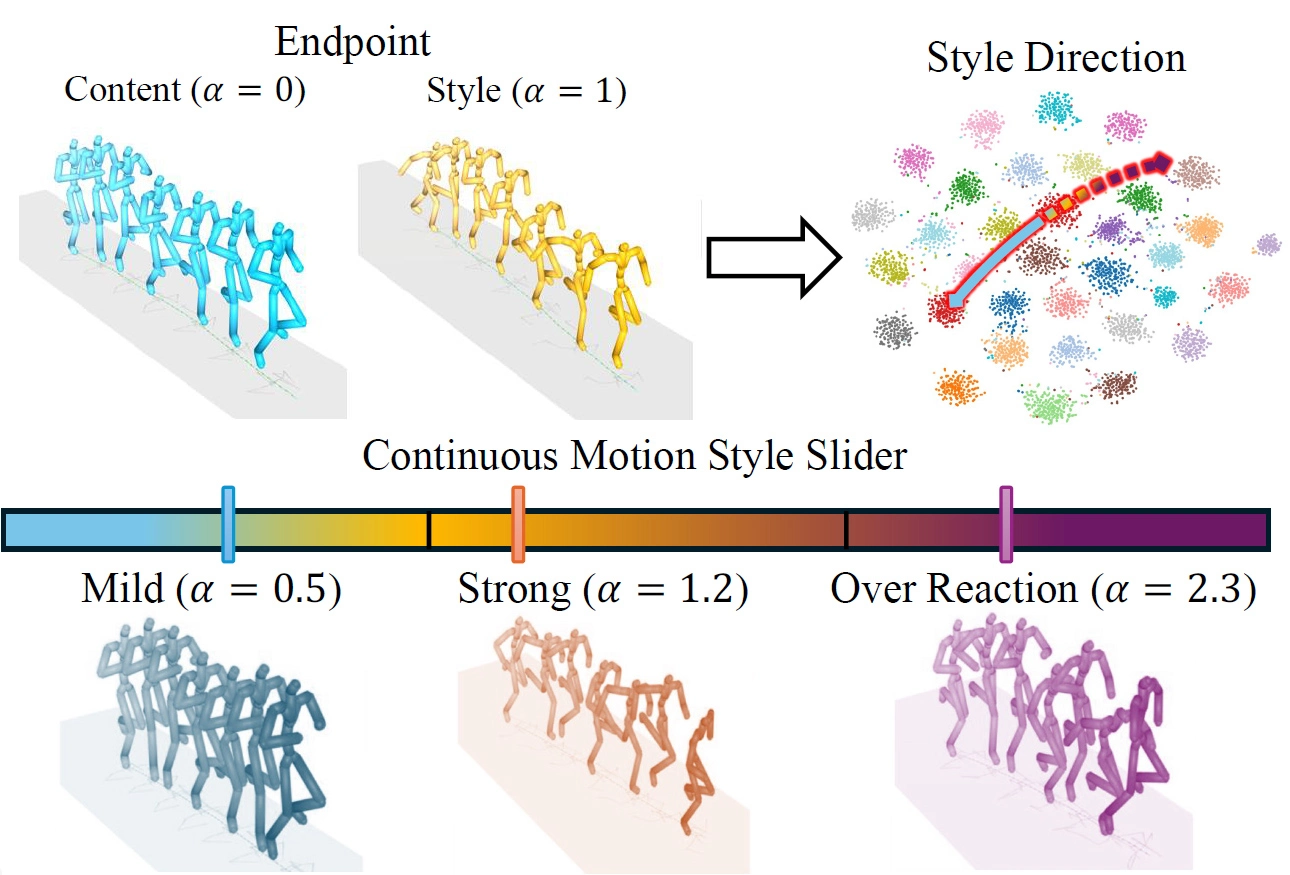
人間の動作を生成するAIで、感情・勢い・誇張などの「動作スタイル」を連続的に調整できる「Motion Style Slider」を開発した研究。東京科学大学とCygamesの研究チームは、通常の動作とスタイルを付加した動作という2つの端点データだけを用いて、スタイルの変化方向を学習する手法を提案した。中間的な強度の教師データを大量に収集する必要がなく、生成時にスライダー値を変更することで、ニュートラルな動きから強調された表現まで滑らかに制御できる。拡散モデルに動作内容とスタイル情報を分離して入力し、強度の直線性・単調性を学習させることで、予測可能な変化を実現。ゲーム、映像、アニメーション、バーチャルキャラクター制作で、演出意図に応じた直感的な動作編集への応用が期待される。
キャラクター動作のニュアンスを連続制御する生成AIー感情・勢い・誇張の度合いを中間データなしでコントロールー
図1. Motion Style Sliderの概要
入力となる通常の動作とスタイル付き動作を基に、スライダー値αを変えることで、スタイルの強さを連続的に制御して動作を生成する。

<関連情報>

モーションスタイルスライダー:人間の動きの拡散のためのエンドポイント監視型連続スタイル制御 Motion Style Slider: Endpoint-Supervised Continuous Style Control for Human Motion Diffusion

Chen-Chieh Liao, Yichen Peng, Yiyi Cai, Yûi Ono, Hiroki Hanaoka, Erwin Wu, Hideki Koike, Shuichi Kurabayashi
European Conference on Computer Vision 2026(ECCV 2026)

Abstract

Existing human motion diffusion methods provide strong motion generation quality [35], and recent style transfer models can inject target style cues [11,33], but fine-grained continuous control of style intensity remains underexplored. In production, style intensity is subjective across artists and directors, so the practical requirement is not a universal absolute unit (e.g., globally correct “2×”), but a reliable monotonic control axis. We propose Motion Style Slider, a motion-to-motion style transfer framework for endpoint-supervised continuous control. Given a content motion and a style motion, we construct a style direction in a learned motion-style embedding space and condition diffusion generation with a scalar intensity α. The training objective combines diffusion denoising with latent intensity regularization to encourage smooth and monotonic style scaling without requiring intermediate-intensity groundtruth motions. Our framework is compatible with pretrained motion diffusion backbones and supports heterogeneous style datasets, including the multi-actor style motion dataset [20]. To test out-of-range usability, we additionally introduce a small real-capture over-reaction extension and evaluate large-α behavior against these unseen targets. Experiments measure controllability, interpolation/extrapolation behavior, content preservation, and motion realism, with ablations on direction construction and loss design.

1600情報工学一般
ad
ad
Follow
ad
タイトルとURLをコピーしました