2026-08-05 東北大学
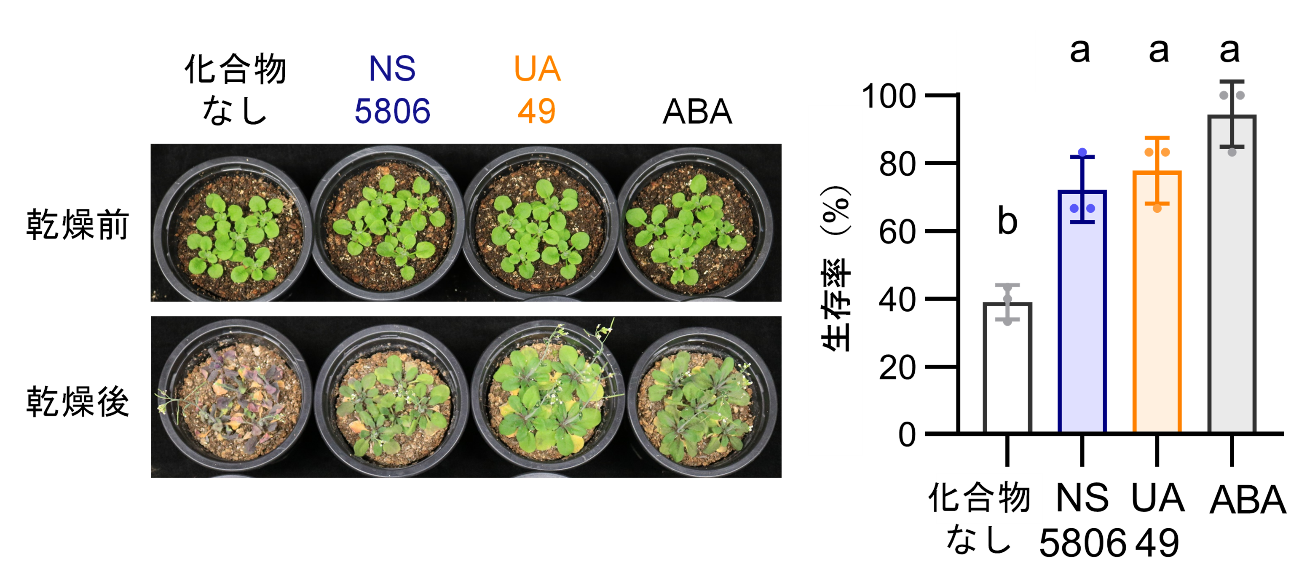
図1. NS5806/UA49による植物への乾燥耐性付与
NS5806またはUA49を植物に噴霧後、水やりを停止し、再給水後の回復状況を評価した。
<関連情報>
- https://www.tohoku.ac.jp/japanese/2026/08/press20260805-03-drought.html
- https://www.nature.com/articles/s41467-026-75894-w
合成イオンチャネル阻害剤は植物の干ばつ耐性を高める Synthetic ion channel inhibitors enhance plant drought tolerance
Kanane Sato,Kyota Suzuki,Shunya Saito,Taishin Kakei,Megumi Kato,Masana Yazaki,Yasutaka Kawai,Mieko Arisawa,Nobuhisa Isaka,Toshio Yamaguchi,Matteo Grenzi,Laura Luoni,Masaru Kono,Yuki Hayashi,Toshinori Kinoshita,Farhan Aziz,Khurram Bashir,Motoaki Seki,Asuka Kamimura,Takumi Higaki,Jun Takeuchi,Yasushi Todoroki,Huifei Yin,Francisco Rubio,… Nobuyuki Uozumi
Nature Communications Published:27 July 2026
DOI:https://doi.org/10.1038/s41467-026-75894-w
Abstract
Drought stress significantly threatens global food security. According to the FAO2024, agriculture absorbs up to 80% of drought impacts. Stomata are vital pores for gas exchange and transpiration in plants. Stomatal closure, which is crucial for drought tolerance, is regulated by ion transport systems. Here, we identify two inhibitors of plasma membrane voltage-dependent potassium (K+) channels, NS5806 and UA49, that induce stomatal closure, reduce guard cell K+ levels, and increase drought resistance in Arabidopsis plants. This chemical-induced stomatal closure pathway is distinct from the abscisic acid (ABA). Notably, K+ channel inhibition led to increased cytosolic Ca2+, which was absent in K+ inward channel mutants, highlighting the link between K+ channel activity and cytosolic Ca2+ elevation. These findings suggest that the chemical regulation of K+ channels represents a strategy to induce stomatal closure, potentially improving plant drought tolerance through targeted interventions.