2026-05-14 産業技術総合研究所
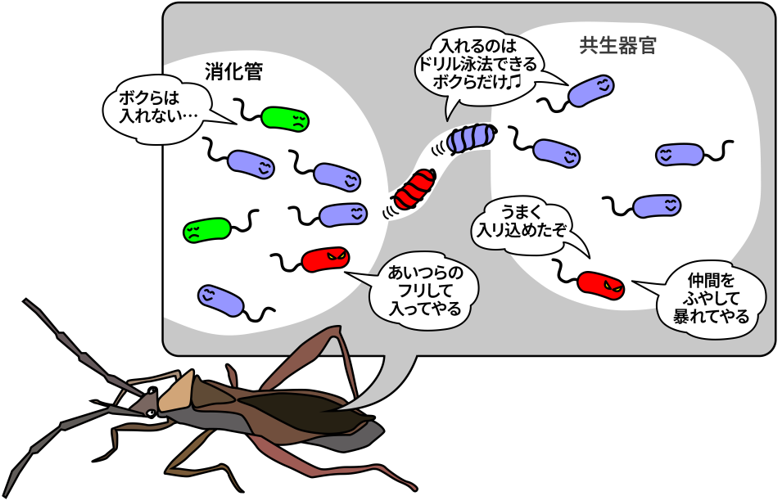
あたかも共生微生物のように振るまって共生器官に侵入し、宿主害虫を殺してしまう病原微生物を発見!
<関連情報>
- https://www.aist.go.jp/aist_j/press_release/pr2026/pr20260514/pr20260514.html
- https://www.pnas.org/doi/10.1073/pnas.2533244123
昆虫の腸内でパートナー選択の障壁を突破するトロイの木馬型病原体 A Trojan horse pathogen breaking through partner-choice barriers in the insect gut
Kota Ishigami, Seonghan Jang, Aoba Yoshioka, +7 , and Yoshitomo Kikuchi
Proceedings of the National Academy of Sciences Published:April 28, 2026
DOI:https://doi.org/10.1073/pnas.2533244123
Significance
In mutualistic symbioses, hosts have evolved diverse partner-choice mechanisms to exclude exploiters that could otherwise destabilize the association. These mutualistic systems are thought to be robust despite their inherent vulnerability to exploitation, and cases in which such systems are disrupted are rare. Here, we report a striking exception in the stinkbug Riptortus pedestris–Caballeronia insecticola symbiosis, a highly evolved mutualism with sophisticated mechanisms of symbiont selection. We identified a pathogenic bacterium, Burkholderia sp. SJ1, which successfully colonizes the symbiotic organ from where it subsequently causes lethal systemic infection. Our findings reveal that even highly specialized and well-defended mutualistic systems can be breached by pathogens, highlighting the critical role of specialized exploiters in shaping host partner-choice mechanisms.
Abstract
Mutualistic symbioses are potentially vulnerable to exploitation, particularly in hosts that acquire symbionts from the environment, where harmful exploiters inhabit. The independent evolution and persistence of intricate partner-choice mechanisms in many symbioses testify the threat by specialized exploiters of mutualisms, although only few have been documented in nature. We report here a lethal “Trojan horse” pathogen, Burkholderia sp. SJ1, exploiting the stinkbug–Caballeronia gut symbiosis. This bacterium resembles symbionts by using wrapping motility to traverse the host’s sorting organ, inducing symbiotic organ morphogenesis and colonizing it. Unlike mutualists, however, it resists host digestion for nutrient acquisition, breaches the gut epithelium, and causes sepsis, rapidly killing the host. Colonization of the symbiotic organ is essential for its lethality. This case shows how pathogens can exploit mutualisms, highlighting the evolutionary pressures shaping partner-choice mechanisms and the fragility of even highly specialized mutualisms.