2026-11-09 名古屋大学
<関連情報>
- https://www.nagoya-u.ac.jp/researchinfo/result/2026/11/1-74.html
- https://www.nature.com/articles/s42003-026-11263-z
トランスクリプトームバイオマーカーにより、シロイヌナズナにおける野外での草食動物による食害下でのジャスモン酸およびサリチル酸の状態が明らかになった Transcriptomic biomarkers reveal jasmonic and salicylic acid states under field herbivory in Arabidopsis thaliana
Atsuki Tomita, Taro Maeda, Natsumi Mori-Moriyama, Yasuyuki Nomura, Yuko Kurita, Makoto Kashima, Shigeyuki Betsuyaku, Yasuhiro Sato & Atsushi J. Nagano
Communications Biology Published:06 November 2026
DOI:https://doi.org/10.1038/s42003-026-11263-z
Abstract
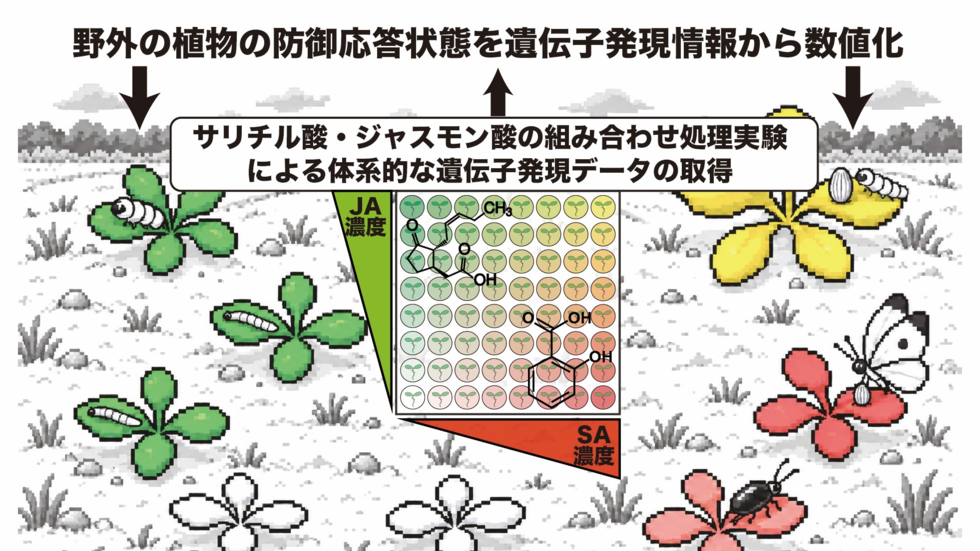
Plants coordinate defence against pathogens and herbivores through the crosstalk between salicylic acid (SA) and jasmonic acid (JA) signalling pathways. However, little is known about how plants integrate the phytohormone concentration profiles to shape defence states in complex field environments. Here we show that systematically varying combinatorial SA and JA concentrations in Arabidopsis thaliana reveals 43 distinct combination-specific transcriptional signatures beyond SA–JA antagonism. Leveraging these data, we develop and validate machine-learning-based transcriptomic biomarkers that independently measure the SA and JA response states from gene-expression data. Applying these biomarkers to field-grown A. thaliana shows that SA/JA response states are associated with the abundance and co-occurrence patterns of herbivores on individual plants. Our study provides a strategy for decoding hormonal responses to biotic environments from field transcriptomes, bridging the gap between molecular signalling and ecological dynamics.