2026-08-04 ローレンス・バークレー国立研究所(LBNL)
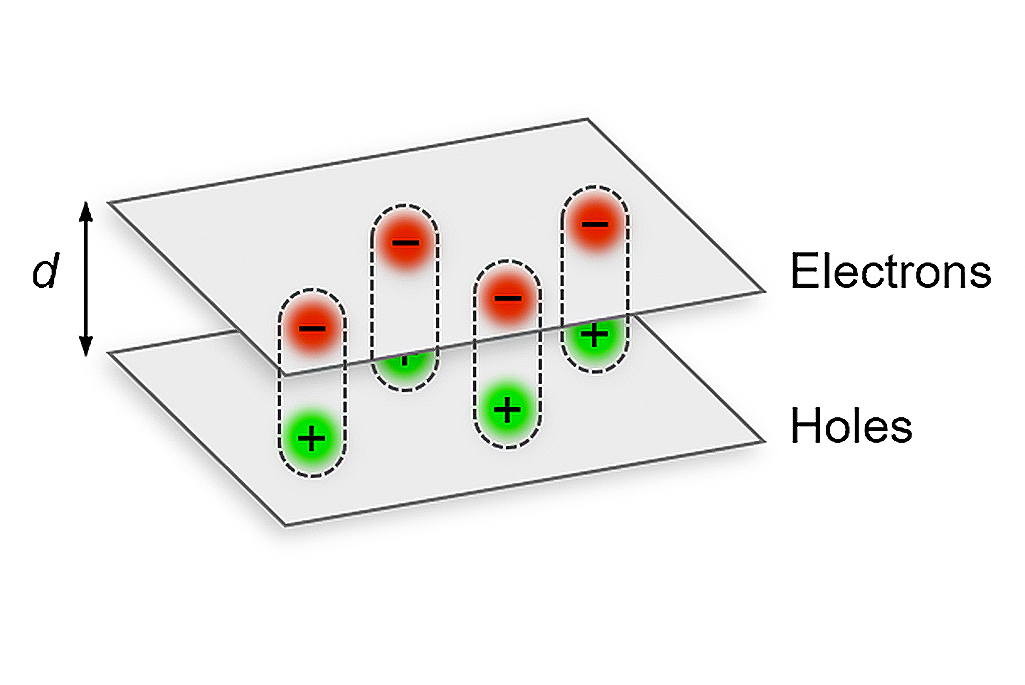
Schematic of a bilayer 2D semiconducting device. (Credit: Ruishi Qi/Berkeley Lab)
<関連情報>
- https://newscenter.lbl.gov/2026/08/04/scientists-reveal-hidden-structure-of-a-quantum-fluid/
- https://www.nature.com/articles/s41586-026-10636-y
電子-正孔二重層における二成分励起子凝縮 Two-component exciton condensates in an electron–hole bilayer
Ruishi Qi,Qize Li,Jiahui Nie,Ruichen Xia,Haleem Kim,Hyungbin Lim,Jingxu Xie,Takashi Taniguchi,Kenji Watanabe,Michael F. Crommie,Allan H. MacDonald & Feng Wang
Nature Published:10 June 2026
DOI:https://doi.org/10.1038/s41586-026-10636-y
Abstract
Macroscopic quantum coherence emerges when bosons condense into a Bose–Einstein condensate (BEC)1,2,3,4,5. Excitons are a long-sought solid-state route to high-temperature BECs with strong interactions, electrical tunability and potentially multicomponent spinor order, but conclusive evidence for equilibrium condensation has remained elusive. Here we report evidence for two-component exciton BECs in MoSe2/hBN/WSe2 electron–hole bilayers6,7,8,9 by probing the spin–valley susceptibility of constituent electrons and holes. This heterostructure hosts equilibrium exciton fluids with four spin–valley flavours. Magneto-optical spectroscopy in a dilution refrigerator reveals three exciton condensate phases with distinct flavour polarizations. At zero magnetic field, the many-body ground state is a coherent superposition of two condensed intravalley exciton flavours. Under a magnetic field, the intravalley exciton condensate first switches to a two-component intervalley condensate through a first-order quantum phase transition at a weak critical field and then turns into a fully polarized single-component condensate at high fields. The condensate signatures form a dome in density–temperature space, persisting up to approximately 1.8 K. Our results establish van der Waals electron–hole bilayers as a versatile platform for strongly interacting, multicomponent exciton BECs.