2026-07-28 中国科学院(CAS)
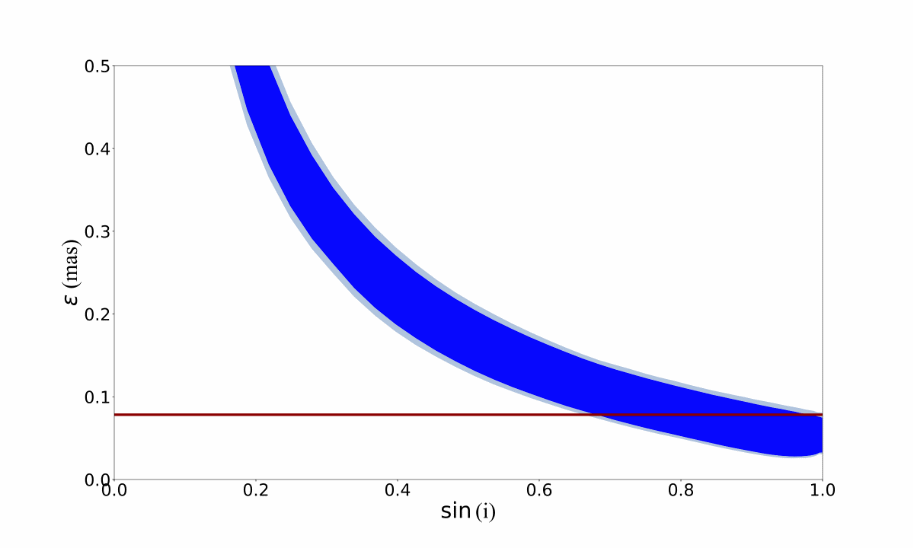
Schematic representation of constraining binary orbital inclination using Gaia DR3 astrometric excess noise. The blue region represents the simulated range of excess noise corresponding to different orbital inclinations, while the red line indicates the excess noise provided by the Gaia DR3 catalog. (Image by SHAO)
<関連情報>
- https://english.cas.cn/newsroom/research-news/202607/t20260728_1179316.shtml
- https://www.aanda.org/articles/aa/full_html/2026/06/aa52921-24/aa52921-24.html
Gaia DR3の天体位置測定過剰ノイズを用いた連星系軌道傾斜角の制約 Constraining the inclination of binary system orbits with the astrometric excess noise from Gaia DR3
Shilong Liao, Ye Ding, Shangyu Wen, Zhaoxiang Qi and Qiqi Wu
Astronomy & Astrophysics Published:01 July 2026
DOI:https://doi.org/10.1051/0004-6361/202452921
Abstract
Context. Orbital inclination is crucial in determining the binary mass. The astrometric excess noise contains the orbital motion information, which can be used to constrain the inclination.
Aims. We aim to constrain the orbital inclination of a binary system by combining radial velocity measurements with the astrometric excess noise from the Gaia DR3 solution.
Methods. The astrometric excess noise is directly related to the orbital parameters. For a binary system with a radial velocity solution, it can be treated as a function of the orbital inclination. Using the Gaia nominal scanning law and the estimated centroid uncertainties, we simulate Gaia astrometric epoch observations to reproduce the expected excess noise. By sampling different inclinations and comparing the resulting simulated excess noise with the value reported in Gaia DR3, we can constrain the inclination to a specific interval.
Results. We have developed a method to constrain the orbital inclination within a specific range, enabling a more accurate determination of the binary mass, particularly for spectroscopic binaries. Internal and external validations demonstrate the robustness of the method, although certain limitations remain. It is most reliable for systems exhibiting a strong astrometric signal of binary motion, while caution is required when applying it to binaries with weak astrometric wobbles or poorly sampled orbits.