2026-07-28 中国科学院(CAS)
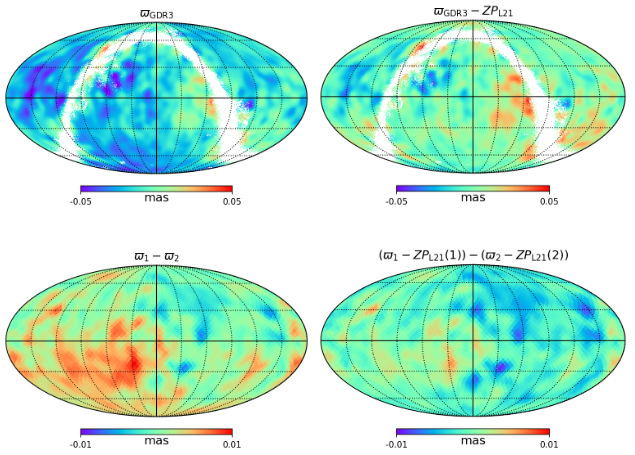
Sky maps present the mean parallaxes of the quasar sample (top row) and the mean parallax differences of the wide binary sample (bottom row). (Image by SHAO)
<関連情報>
- https://english.cas.cn/newsroom/research-news/202607/t20260728_1179317.shtml
- https://academic.oup.com/mnras/article/550/1/stag1115/8706374?login=false
Gaia DR3の視差ゼロ点の 精度向上:グローバルパラメトリック補正とローカル精度向上を組み合わせたハイブリッドアプローチ Refining the Gaia DR3 parallax zero-point: a hybrid approach combining Global Parametric Correction with Local Refinement
Ye Ding,Shilong Liao,Zhaoxiang Qi,Qiqi Wu,Qi Xu,Keyu Zhu
Monthly Notices of the Royal Astronomical Society Published:11 June 2026
DOI:https://doi.org/10.1093/mnras/stag1115
ABSTRACT
The Gaia Data Release 3 (GDR3) parallaxes are affected by a complex bias that depends on stellar magnitude, colour, and celestial position, with amplitudes reaching tens of microarcseconds (as). Standard global parametric models (e.g., the L21 model) effectively remove large-scale trends but struggle to resolve small-scale spatial systematics due to functional rigidity. We aim to construct a flexible, data-driven calibration map that eliminates these residual local systematics without imposing rigid functional forms. We propose a ‘Global Pre-correction + Local Refinement’ hybrid strategy. First, we utilize the L21 model as a baseline to remove the dominant magnitude and colour-dependent biases. Second, we model the residual zero-point using a local non-parametric method based on a Sliding Window technique. This approach fits local trends using k-nearest neighbours from quasars (for faint stars, G≥18) and wide binaries combined with Large Magellanic Cloud (LMC) (for bright stars, G<18). Our hybrid model demonstrates significant improvements over the standard L21 solution. Validation against different samples reveals a remarkably flat residual map with near-zero bias across the full sky. Our mathematical attempt at calibrating the parallax zero-point is expected to provide a useful reference for the zero-point correction in future Gaia DR4, and to help move towards a physical resolution of this issue.