2026-05-28 韓国基礎科学研究院(IBS)
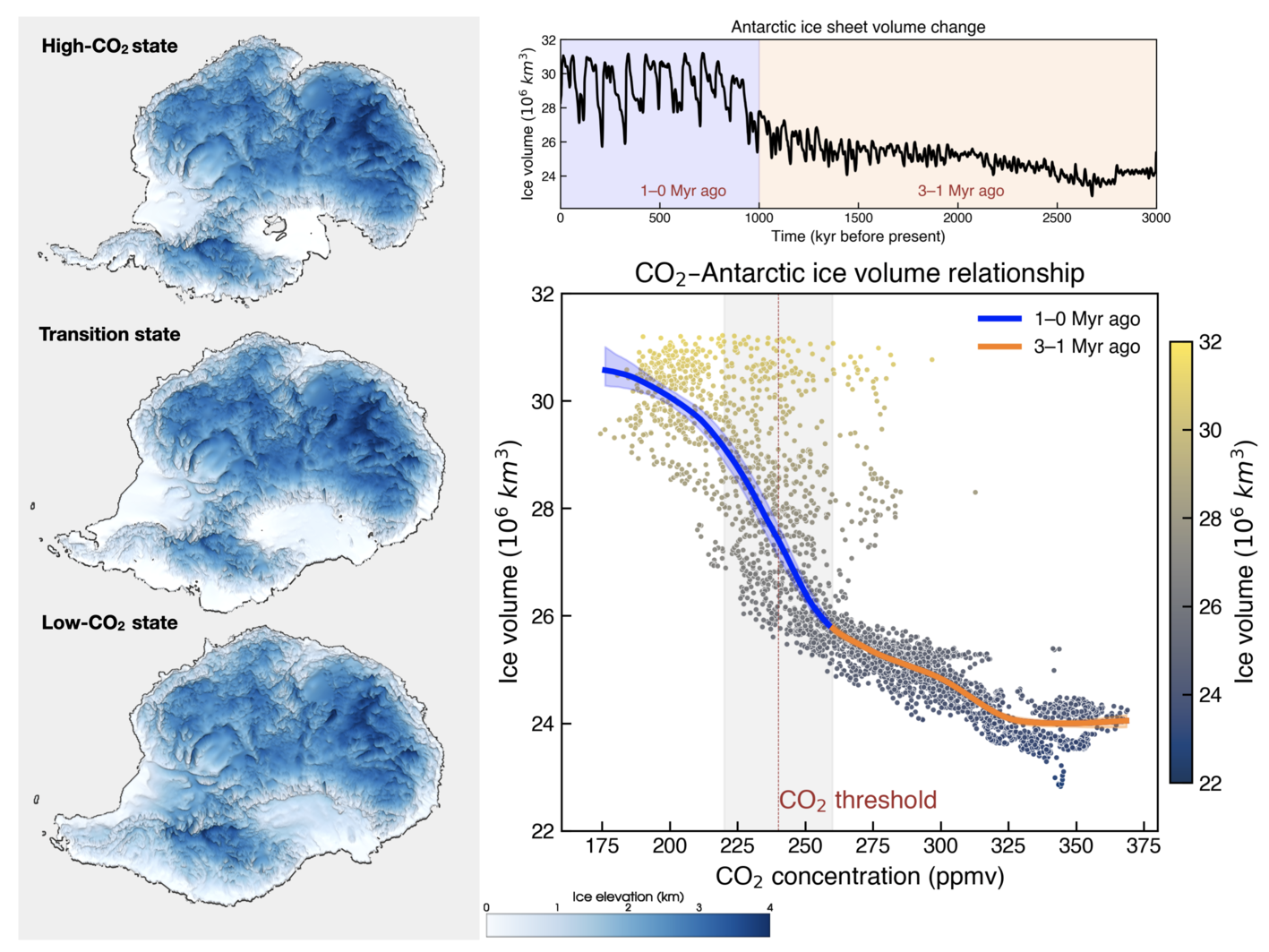
Figure 1. Relationship between atmospheric CO2 concentration and Antarctic ice volume
<関連情報>
- https://www.ibs.re.kr/cop/bbs/BBSMSTR_000000000738/selectBoardArticle.do?nttId=26718&pageIndex=1&searchCnd=&searchWrd=
- https://www.nature.com/articles/s41561-026-01979-2
- https://cp.copernicus.org/articles/19/1951/2023/
中期更新世移行期における南極氷床の二酸化炭素濃度低下に対する感受性の増大 Increased sensitivity of the Antarctic Ice Sheet to decreasing CO2 across the Mid-Pleistocene Transition
Kyung-Sook Yun & Axel Timmermann
Nature Geoscience Published:28 May 2026
DOI:https://doi.org/10.1038/s41561-026-01979-2
Abstract
Ice sheet model simulations show that continued warming due to rising greenhouse gas concentrations could lead to a rapid decline of the Antarctic Ice Sheet volume, resulting in increased global sea-level rise and coastal flooding. It has been challenging to test such models against palaeoclimate records owing to the lack of spatially continuous global climate forcing needed to drive transient (time-evolving) simulations. Here we use the Penn State University bihemispheric ice sheet–ice shelf model and realistic climate fields from the Community Earth System Model to simulate the evolution of global ice sheets over the past 3 million years. Our study identifies a nonlinear regime shift in the Antarctic Ice Sheet during the Mid-Pleistocene Transition, marked by an increased sensitivity of the ice sheet to declining atmospheric CO2 levels below ~240 ppmv. Additional experiments reveal that decreases in Antarctic temperatures and sea level after the Mid-Pleistocene Transition, combined with bedrock dynamics and changes in ice mass balance, accelerated Antarctic Ice Sheet growth during cold glacial intervals. Our discovery of past threshold behaviour in the Antarctic Ice Sheet highlights the potential for nonlinear responses of the ice sheet to future climate forcing and their implication for global sea-level change.
過去300万年間の過渡的な結合大気大循環モデル(CGCM)シミュレーション A transient coupled general circulation model (CGCM) simulation of the past 3 million years
Kyung-Sook Yun, Axel Timmermann, Sun-Seon Lee, Matteo Willeit, Andrey Ganopolski, and Jyoti Jadhav
Climate of the Past Published:13 Oct 2023
DOI:https://doi.org/10.5194/cp-19-1951-2023
Abstract
Driven primarily by variations in the earth’s axis wobble, tilt, and orbit eccentricity, our planet experienced massive glacial/interglacial reorganizations of climate and atmospheric CO2 concentrations during the Pleistocene (2.58 million years ago (Ma)–11.7 thousand years ago (ka)). Even after decades of research, the underlying climate response mechanisms to these astronomical forcings have not been fully understood. To further quantify the sensitivity of the earth system to orbital-scale forcings, we conducted an unprecedented quasi-continuous coupled general climate model simulation with the Community Earth System Model version 1.2 (CESM1.2, ∼3.75∘ horizontal resolution), which covers the climatic history of the past 3 million years (3 Myr). In addition to the astronomical insolation changes, CESM1.2 is forced by estimates of CO2 and ice-sheet topography which were obtained from a simulation previously conducted with the CLIMBER-2 earth system model of intermediate complexity. Our 3 Ma simulation consists of 42 transient interglacial/glacial simulation chunks, which were partly run in parallel to save computing time. The chunks were subsequently merged, accounting for spin-up and overlap effects to yield a quasi-continuous trajectory. The computer model data were compared against a plethora of paleo-proxy data and large-scale climate reconstructions. For the period from the Mid-Pleistocene Transition (MPT, ∼1 Ma) to the late Pleistocene we find good agreement between simulated and reconstructed temperatures in terms of phase and amplitude (−5.7 ∘C temperature difference between Last Glacial Maximum and Holocene). For the earlier part (3–1 Ma), differences in orbital-scale variability occur between model simulation and the reconstructions, indicating potential biases in the applied CO2 forcing. Our model-proxy data comparison also extends to the westerlies, which show unexpectedly large variance on precessional timescales, and hydroclimate variables in major monsoon regions. Eccentricity-modulated precessional variability is also responsible for the simulated changes in the amplitude and flavors of the El Niño–Southern Oscillation. We further identify two major modes of planetary energy transport, which played a crucial role in Pleistocene climate variability: the first obliquity and CO2-driven mode is linked to changes in the Equator-to-pole temperature gradient; the second mode regulates the interhemispheric heat imbalance in unison with the eccentricity-modulated precession cycle. During the MPT, a pronounced qualitative shift occurs in the second mode of planetary energy transport: the post-MPT eccentricity-paced variability synchronizes with the CO2 forced signal. This synchronized feature is coherent with changes in global atmospheric and ocean circulations, which might contribute to an intensification of glacial cycle feedbacks and amplitudes. Comparison of this paleo-simulation with greenhouse warming simulations reveals that for an RCP8.5 greenhouse gas emission scenario, the projected global mean surface temperature changes over the next 7 decades would be comparable to the late Pleistocene glacial-interglacial range; but the anthropogenic warming rate will exceed any previous ones by a factor of ∼100.