2026-06-19 東京科学大学
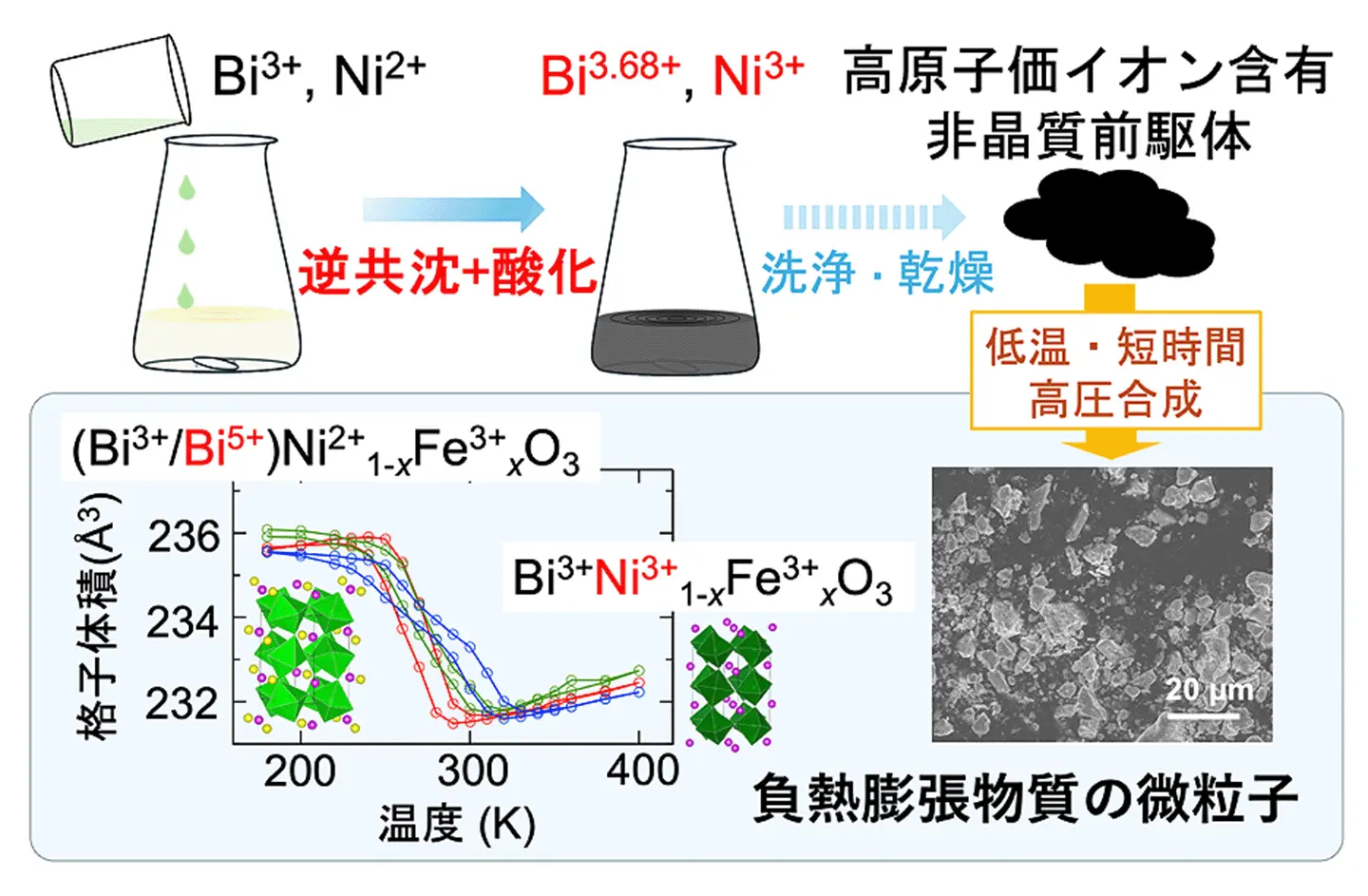
図1. 本研究で開発した共沈酸化同時プロセスの概略。
<関連情報>
高度に酸化された共沈前駆体からの異常に高い原子価のペロブスカイト酸化物の合成 Synthesis of Unusually High Valent Perovskite Oxide from the Highly Oxidized Coprecipitation Precursor
Takumi Nishikubo,Ryan J. Paull,Takatoshi Hirooka,Kana Matsuno,Koki Maebayashi,Jiong Ding,Hidetaka Kasai,Shigeo Mori,Takafumi Yamamoto,Kenneth R. Poeppelmeier,and Masaki Azuma
Journal of the American Chemical Society Published: June 18, 2026
DOI:https://doi.org/10.1021/jacs.6c04051
Abstract
Perovskite oxides containing cations with unusually high-valent states such as Fe4+, Ni3+, and Cu3+ have attracted significant attention, often requiring a strong oxidizing atmosphere. This study addresses the challenges associated with the conventional precursor preparation for the high-pressure synthesis of BiNi1–xFexO3, a material exhibiting negative thermal expansion (NTE), specifically the need for mixed oxidants and the emission of NOx. We successfully established a modified method for preparing a highly oxidized, amorphous precursor containing Bi5+ and Ni3+ ions, ensuring high elemental dispersion by employing a reverse coprecipitation method with simultaneous oxidation using hypochlorite ions, enabling the synthesis of the target phase without the addition of external oxidizing agents. When subjected to high-pressure and high-temperature treatment, the BiNi1–xFexO3 phase crystallized directly from the amorphous precursor at a relatively low temperature (750 °C) and in a short time of less than 1 min, unlike the crystalline precursor prepared by conventional methods. Furthermore, leveraging the advantage of direct crystallization from the amorphous phase, we demonstrated that reducing the heating duration allows for the fabrication of fine particles, decreasing the size from 15 to 5 μm. These fine particles exhibited NTE over a wider temperature range without any degradation of the volume shrinkage magnitude. This synthetic method provides a safe, pollution-free, and potentially scalable route for BiNi1–xFexO3 fine particles and is expected to be applicable to the synthesis of other oxides containing anomalously high-valent ions.