2026-05-06 NASA
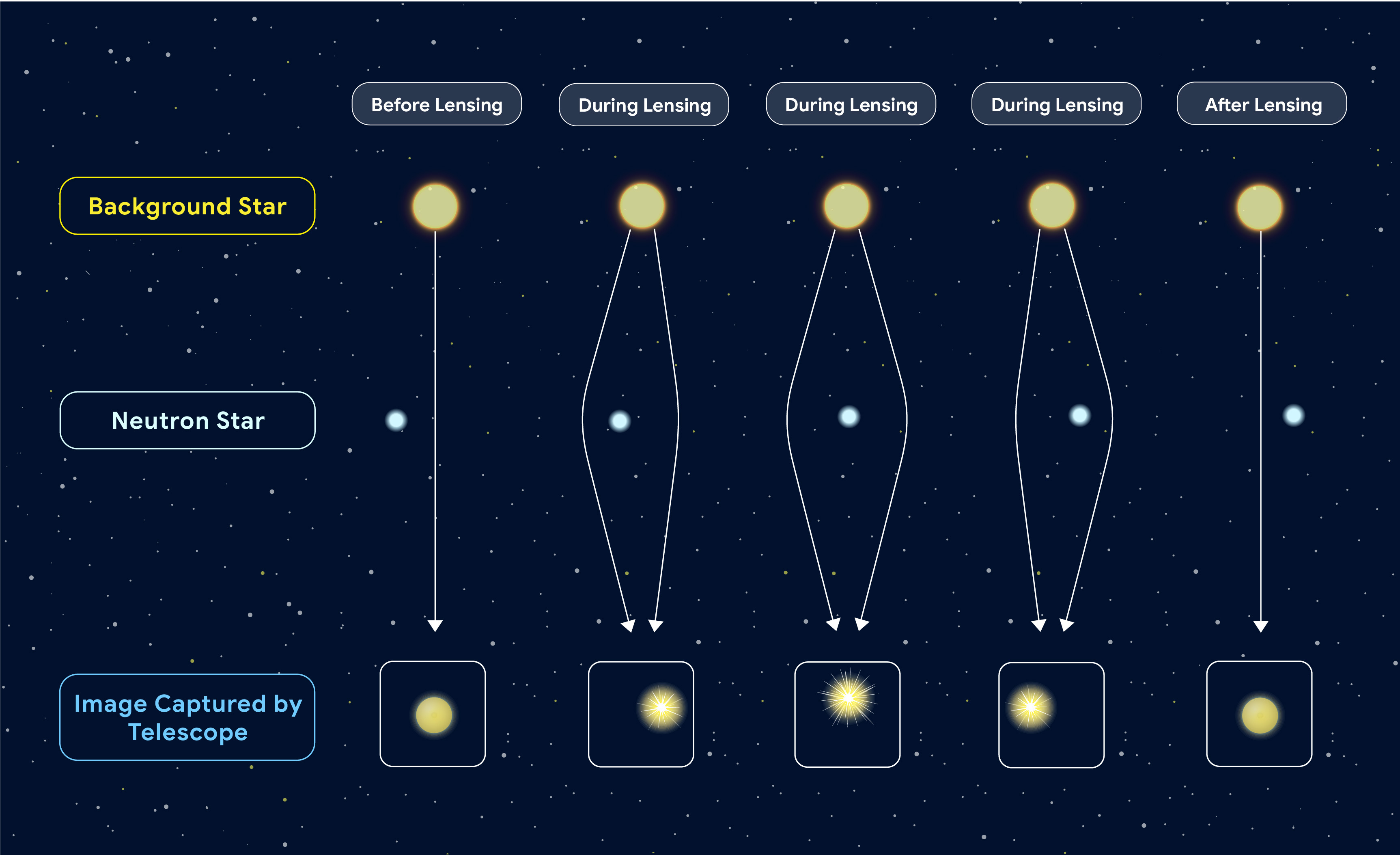
Astrometric microlensing occurs when a foreground object, like a neutron star, passes in front of a more distant background star. The neutron star’s gravity bends the distant star’s light, splitting it into multiple paths that reach the telescope. Although these distorted images can’t be resolved, their combined light appears brighter and slightly shifted from the distant star’s true position. As the alignment between the two objects changes over time, this apparent shift traces a small elliptical pattern on the sky. The size of that ellipse depends on how strongly the light is bent, meaning more massive objects produce larger shifts, allowing astronomers to directly measure the mass of the otherwise invisible neutron star.NASA, STScI, Joyce Kang (STScI)
<関連情報>
- https://www.nasa.gov/missions/roman-space-telescope/nasas-roman-poised-to-transform-hunt-for-elusive-neutron-stars/
- https://www.aanda.org/articles/aa/full_html/2026/03/aa58238-25/aa58238-25.html
ローマンによる孤立中性子星集団の天体位置測定マイクロレンズ探査 Astrometric microlensing probes of the isolated neutron star population with Roman
Z. Kaczmarek, A. Halasi-Kun, P. McGill, S. E. Perkins and W. A. Dawson
Astronomy & Astrophysics Published:08 April 2026
DOI:https://doi.org/10.1051/0004-6361/202558238
Abstract
Context. Notoriously hard to detect and study, isolated neutron stars (NSs) might provide valuable answers to fundamental questions about stellar evolution and explosion physics. With the upcoming Roman Space Telescope, scheduled for launch in 2026, a new and powerful channel for their detection will become available: astrometric microlensing.
Aims. We set out to create a realistic sample of simulated gravitational microlensing events as observed by Roman with the Galactic Bulge Time Domain Survey. We focus in particular on the population of NS lenses, which has until now been largely understudied.
Methods. We used dedicated Galactic models tailored for application to microlensing by compact objects. In addition to populations of stars, white dwarfs, and black holes, we simulated four different NS populations with Maxwellian natal kick distributions: v = (150, 250, 350, 450) km/s. For each simulation, we applied projected Roman precision, cadence, and detectability criteria.
Results. We found that the parameter space log10 tE–log10 θE, which will be accessible to Roman observations, is efficient for the classification of stellar remnants. We found a feature in this space that is characteristic of NSs; using this feature, optimal samples of NS candidates can be constructed from Roman-like datasets. We describe the dependence of the observable parameter distributions on the assumed mean kick velocities. As the effects of natal kicks are very complex and mutually counteracting, we suggest that more detailed studies focused on the dynamics of NSs are needed in anticipation of Roman and future surveys. We estimate that Roman will observe approximately 11 000 microlensing events, including ~100 with NS lenses, whose photometric and astrometric signals are detectable; the event yield decreases by 38% when gap-filling low-cadence observations are not included. We make all simulated microlensing event datasets publicly available in preparation for Roman data.