2025-09-08 ニューヨーク大学 (NYU)
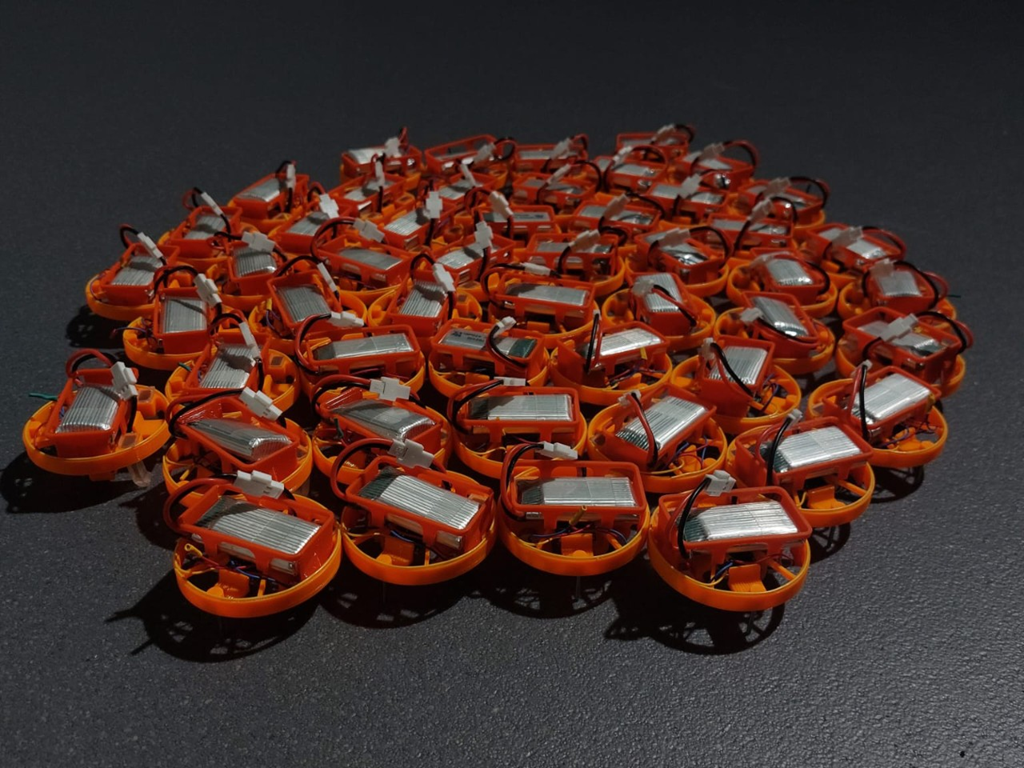
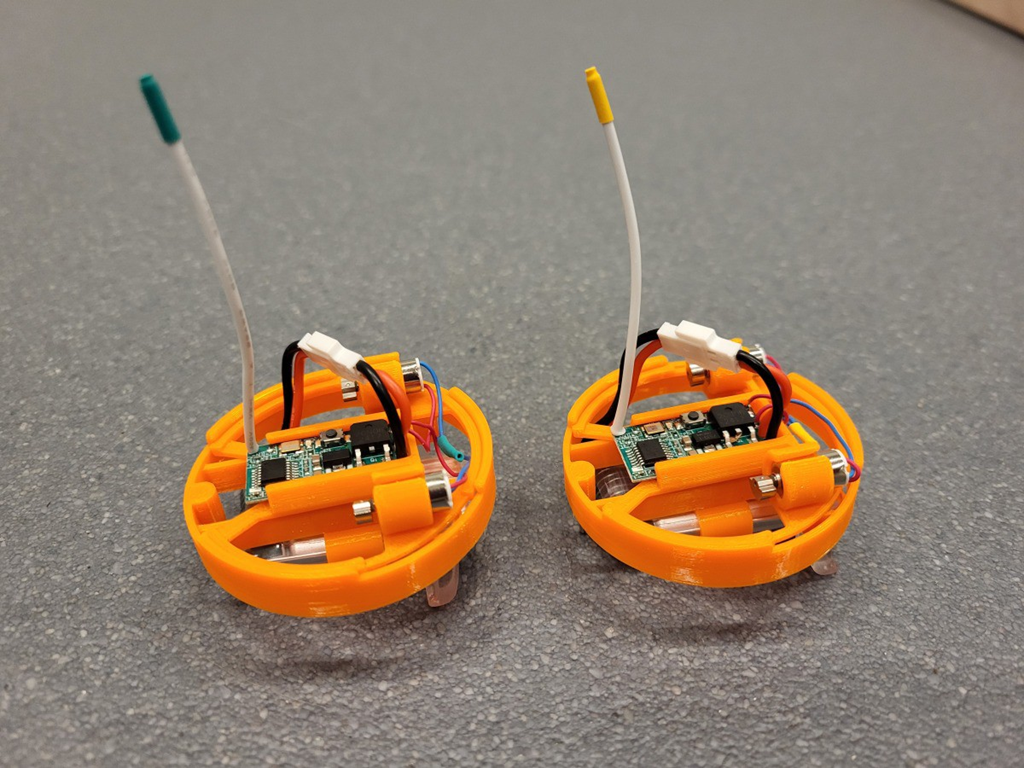
Pictured above are robots, used in the Proceedings of the National Academy of Sciences study, that have the potential to advance “artificial swarm intelligence”—a type of AI that mimics flocking birds and schooling fish. Image courtesy of the Department of Artificial Intelligence, the Donders Center for Cognition, Radboud University. Photo Credit: Luco Buise.
<関連情報>
- https://www.nyu.edu/about/news-publications/news/2025/september/scientists-find-curvy-answer-to-harnessing–swarm-intelligence—.html
- https://www.pnas.org/doi/10.1073/pnas.2502211122
ロボット群の結束性と群集-群れ遷移のための幾何学的条件 A geometric condition for robot-swarm cohesion and cluster–flock transition
Mathias Casiulis, Eden Arbel, Charlotte van Waes, +3 , and Matan Yah Ben Zion
Proceedings of the National Academy of Sciences Published:September 8, 2025
DOI:https://doi.org/10.1073/pnas.2502211122
Significance
Robotic swarms, ensembles of collaborative robots that work together to achieve tasks, are an appealing solution to tackle complex tasks such as automated exploration, foraging, or transport. Yet, a scalable swarm cannot rely on an external controller nor complex computation, and requires simple design rules to achieve emergent functions. Viewing robots as self-propelled particles, we show that the size and mass repartition of an individual robot define an intrinsic curvature. This curvature seeds the collective behavior of the swarm, offering a direct design rule to control whether the swarm flocks, flows, or clusters. We thus demonstrate a computation-free route for decentralized control on collective behavior, paving the way for richer swarm robotic applications.
Abstract
We present a geometric design rule for size-controlled clustering of self-propelled particles. We show that active particles that tend to rotate under an external force have an intrinsic, signed parameter with units of curvature which we call curvity, that can be derived from first principles. Experiments with robots and numerical simulations show that properties of individual robots (radius and curvity) control pair cohesion in a binary system, and the stability of flocking and self-limiting clustering in a swarm, with applications in metamaterials and in embodied decentralized control.