

2026-11-19 京都大学
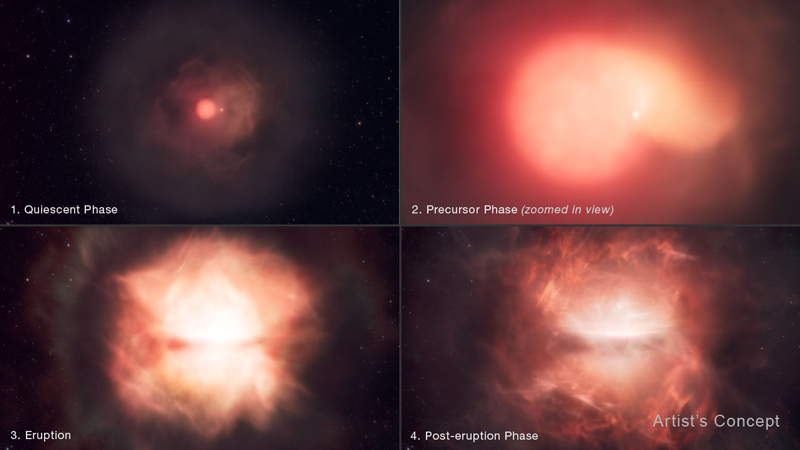
本研究で明らかになった恒星合体過程の想像図(左上→右上→左下→右下の順)©NASA、ESA、CSA、STScI、Leah Hustak(STScI)。
<関連情報>
- https://www.kyoto-u.ac.jp/ja/research-news/2026-11-19
- https://www.nature.com/articles/s41586-026-11221-z
巨星を伴星とする星の共通外層内でのインスパイラル
An inspiral of a star inside a common envelope with its giant companion
Viraj Karambelkar, Kishalay De, Karel D. Temmink, Brian D. Metzger, Nadejda Blagorodnova, G. C. Anupama, Sudhanshu Barway, Judhajeet Basu, Eric C. Bellm, Varun Bhalerao, Aleksandra Bochenek, Shatakshi Chamoli, Kaustav Das, Christoffer Fremling ほかNature 659, 628–633 (2026):2026-11-18
DOI:https://doi.org/10.1038/s41586-026-11221-z
The common-envelope evolution (CEE) of binary stars is thought to play an important role in forming compact stellar binaries, but the inspiral of a companion inside a giant star’s envelope had not previously been observed directly. In this study, the researchers conducted extensive observations of the transient event AT 2025abao in the Andromeda Galaxy and identified evidence of CEE in a binary system consisting of an approximately seven-solar-mass asymptotic giant branch star and a companion of about 0.7 solar masses. The companion is inferred to have entered the giant’s envelope around 2018 and spiralled inward over approximately seven years, releasing orbital energy. A bright eruption occurred in late 2025, ejecting an estimated 0.1–0.2 solar masses of material. The observations provide direct insight into the inspiral process and suggest that existing models may need to be revised to account for how energy is transported and redistributed during common-envelope evolution.
