
2026-11-09 琉球大学
<関連情報>
- https://www.u-ryukyu.ac.jp/news/98377/
- https://bioone.org/journals/zoological-science/volume-44/issue-1/zs250086/Colonization-of-Deep-Sea-Chemosynthesis-Based-Ecosystems-by-a-Single/10.2108/zs250086.full
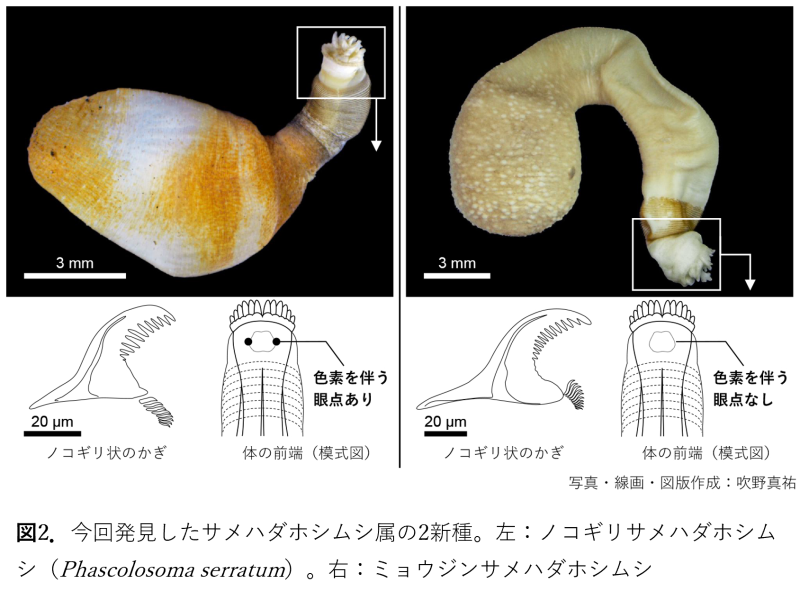
北西太平洋産の2つの新種鉤状 Colonization of Deep-Sea Chemosynthesis-Based Ecosystems by a Single Lineage of Phascolosoma (Annelida: Sipuncula), with Descriptions of Two New Hooked Species from the Northwestern Pacific
Shinsuke Fukino, Takeshi Kon, Yoshihiro Fujiwara, Teruaki Nishikawa
Zoological Science Published:5 November 2026
DOI:https://doi.org/10.2108/zs250086
Abstract
Although taxonomic studies have been increasingly conducted on deep-sea chemosynthesis-based ecosystems, the diversity of sipunculans in these habitats remains insufficiently characterized. To investigate their diversity around the Japanese Archipelago, a taxonomic survey was conducted on deep-sea sipunculan specimens collected from southern Japanese waters during JAMSTEC cruises from 1999 to 2011, spanning hydrothermal vents, hydrocarbon seeps, and whale falls. Morphological and molecular analyses (based on 16S, 18S, and 28S rRNA, COI, H3, and H4 genes) revealed three distinct species of Phascolosoma (subgenus Phascolosoma), two being new to science and possessing introvert hooks serrated along the posterior margin, but morphologically distinguishable by the presence or absence of pigmented eyespots; one was found at hydrothermal vents and whale falls, while the other occurred at vents and hydrocarbon seeps. The third species, occurring across the three habitat types and bearing pigmented eyespots, closely resembled P. turnerae Rice, 1985 from the western Atlantic and Mediterranean, but showed clear genetic divergence, and was therefore identified as P. turnerae complex. The molecular phylogenetic analyses, including divergence time estimation, suggested a single monophyletic origin of Phascolosoma species inhabiting deep-sea chemosynthesis-based ecosystems during the Cretaceous Period. Ancestral character reconstruction indicated that organic-fall ecosystems, such as wood falls, served as evolutionary stepping stones, facilitating the colonization of chemosynthesis-based habitats by sipunculans.

