2026-11-06 産業技術総合研究所
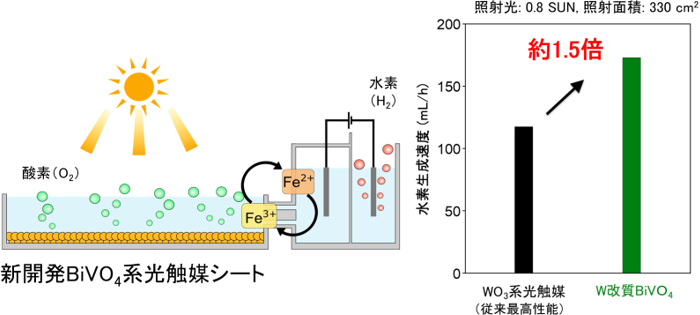
光触媒-電解ハイブリッドシステムの概要とW改質BiVO4光触媒による水素製造性能の向上
※原論文の図を引用・改変したものを使用しています。
<関連情報>
- https://www.aist.go.jp/aist_j/press_release/pr2026/pr20261106/pr20261106.html
- https://pubs.acs.org/accacs/article-abstract/doi/10.1021/acscatal.6c05752/5466166/Surface-Engineered-BiVO4-Photocatalyst-Enables
表面改質されたBiVO4光触媒により、光触媒-電気分解ハイブリッドシステムを介して水分解のための選択的な水酸化が可能になる Surface-Engineered BiVO4 Photocatalyst Enables Selective Water Oxidation for Water Splitting via a Photocatalysis–Electrolysis Hybrid System
Kenta Watanabe; Yugo Miseki; Michiko Tamano; Ryo Kasuya; Kazuhiro Sayama
ACS Catalysis Published:November 07, 2026
DOI:https://doi.org/10.1021/acscatal.6c05752
Abstract
Selective water oxidation in the presence of thermodynamically favored competing oxidation reactions remains a major challenge for photocatalytic systems. BiVO4 is one of the most efficient visible-light-responsive photocatalysts for water oxidation and exhibits high activity in Fe3+-mediated water-oxidation systems. However, although accumulated Fe2+ can introduce competing oxidation pathways under strongly acidic Fe3+/Fe2+ redox conditions, effective strategies for suppressing these processes and maintaining selective water oxidation remain largely unexplored. Here, we demonstrate a surface-engineering strategy that overcomes this limitation in BiVO4. Systematic investigation revealed that the poor activity of BiVO4 under strongly acidic Fe3+/Fe2+ conditions arises not only from catalyst degradation but also from competition with Fe2+ oxidation reactions. Surface modification of BiVO4 with W species, originally intended to improve acid durability, not only suppressed catalyst dissolution but also mitigated Fe2+-related performance losses, resulting in a marked enhancement of photocatalytic water oxidation. The activity enhancement correlated with highly dispersed surface W species localized near the outermost region of BiVO4. Notably, the highest activity was obtained before or near the onset of detectable WO3 crystallization, suggesting that the surface state of W species in this temperature range is more closely associated with the enhanced activity than crystalline WO3 domains under strongly acidic Fe3+/Fe2+ conditions. The optimized photocatalyst maintained efficient water oxidation while suppressing Fe2+-related performance losses, achieving an apparent quantum yield of 63% under Fe3+-based conditions and approximately 30% even under strongly acidic and concentrated Fe(ClO4)3 conditions relevant to hybrid water splitting. The optimized photocatalyst maintained selective water oxidation even as Fe2+ accumulated to approximately 100 mM, enabling nearly quantitative Fe3+-to-Fe2+ conversion under strongly acidic conditions. When incorporated into a photocatalysis–electrolysis hybrid system, the enhanced photocatalytic activity was directly translated into approximately 1.5-fold higher water-splitting performance than that of the benchmark H-Fe-Cs-WO3 system. These findings demonstrate that selective water oxidation can be maintained even in the presence of thermodynamically favored competing oxidation reactions through appropriate photocatalyst surface engineering, providing a useful strategy for photocatalysts operating in redox-mediated reaction environments, including photocatalysis–electrolysis hybrid water-splitting systems.