2026-11-05 筑波大学
(Provided by OCHIAI Yoichi)
<関連情報>
- https://www.tsukuba.ac.jp/journal/technology-materials/20261105141500.html
- https://dl.acm.org/doi/10.1145/3830398.3830685
マッスルジョッキー:筋刺激による運動開始とユーザ制御保持の両立 MuscleJockey: Motor Initiation via Electrical Muscle Stimulation While Preserving User Control
Shieru Suzuki, Seito Matsubara, Akihiko Murai, Yoichi Ochiai
UIST ’26: Proceedings of the 39th Annual ACM Symposium on User Interface Software and Technology Published: 01 November 2026
DOI:https://doi.org/10.1145/3830398.3830685
Abstract
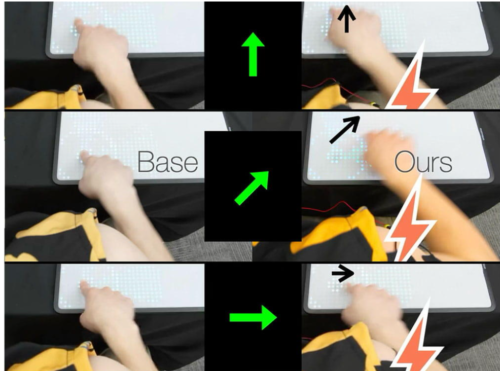
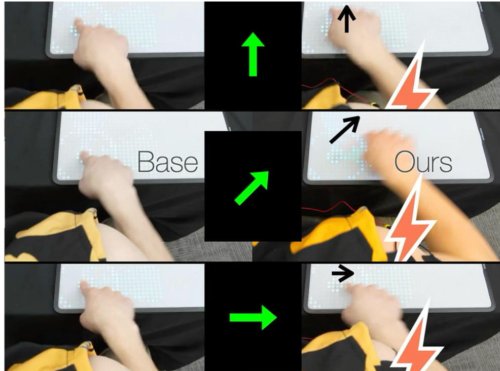
In body-actuation interfaces, due to the difficulty predicting user intention in real time, it is challenging to induce movements while preserving user control. We propose MuscleJockey, a body-actuation interface concept in which the system controls the initiation of a movement, while the user controls the direction of the movement. MuscleJockey is based on the division of roles between machine and human: electrical muscle stimulation applied to the shoulder initiates the movement, while the user handles this initiated movement to reach toward a prepared direction. We conducted a user study in which cues were presented at random times, and participants performed reaching movements toward the direction that had been presented beforehand. Consequently, MuscleJockey resulted in a significantly shorter time from cue to movement onset (63.0 ms shorter than the control condition), while maintaining comparable directional accuracy across conditions. These results provide evidence that the time between cue and movement onset can be reduced while preserving user control. Future work should evaluate user control in precise direction, force, and pointing tasks. We believe this study opens up an alternative design direction for body-actuation interfaces.