2026-11-02 合肥物質科学研究院(HFIPS)
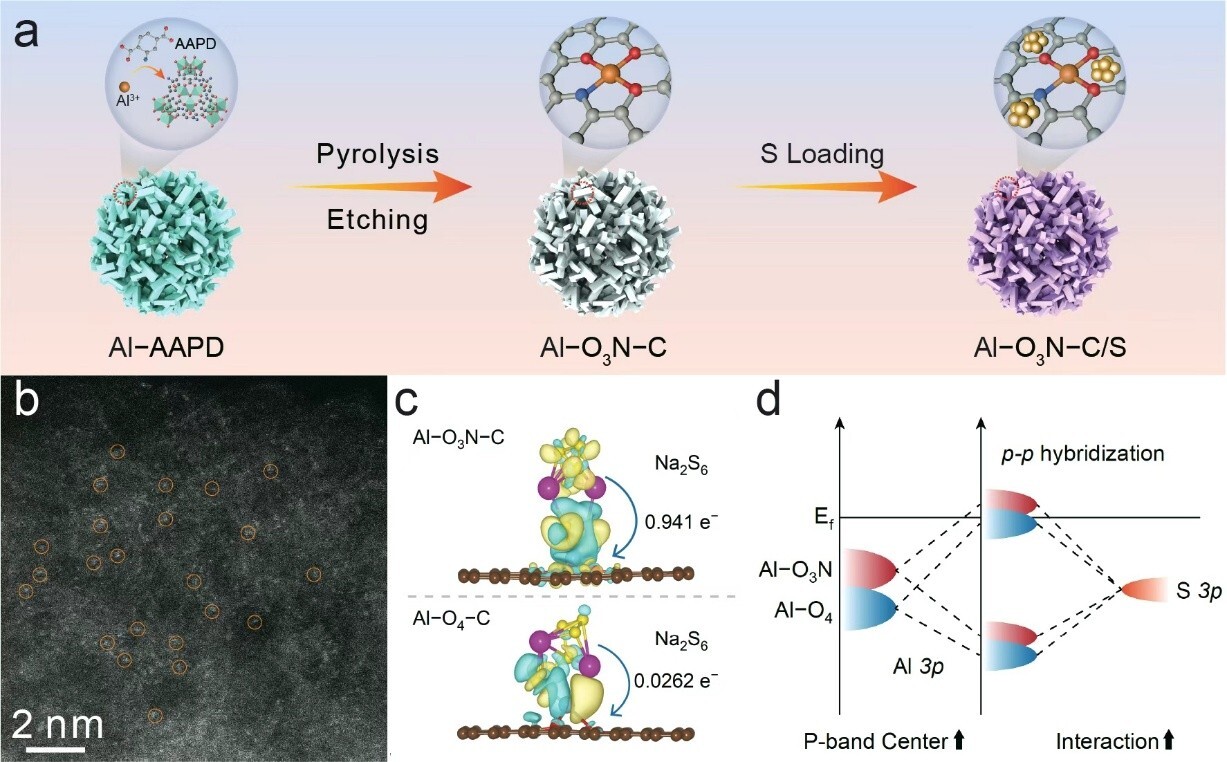
This illustrates the synthesis schematic, structural characterization, electron transfer process during Na2S6 adsorption, and the p–p orbital hybridization interaction between Al single atoms and sodium polysulfides. (Image by ZHENG Fangcai)
<関連情報>
- https://english.hf.cas.cn/nr/rn/202611/t20261102_1213013.html
- https://onlinelibrary.wiley.com/doi/10.1002/ange.9140872
安定なNa─S電池のための非対称配位pブロックアルミニウム単原子サイト Asymmetrically Coordinated p-Block Aluminum Single-Atom Sites for Stable Na─S Batteries
Fangcai Zheng, Fangsheng Chen, Jiayao Yu, Sheng Yao, Chen Shen, Zhicheng Huang, Zhiqiang Li, Changlai Wang, Hui Wang
Angewandte Chemie Published: 16 September 2026
DOI:https://doi.org/10.1002/ange.9140872
Abstract
Main-group metal single-atom catalysts (SACs) are promising for sodium−sulfur (Na─S) batteries owing to their low toxicity and economic viability, yet their inherently poor catalytic activity limits the electrochemical performance. Moreover, the electronic interplay involving p-p orbital hybridization between p-block metal SACs and sodium polysulfides (Na2Sn) remains unclear. Herein, we design efficient aluminum (Al) SACs with a planar asymmetrical Al─O3N coordination anchored on carbon materials (Al─O3N─C) for Na─S batteries. The introduced N ligand breaks the coordination symmetry, creating localized charge at the Al sites, which enhances p-p orbital hybridization between Al-3p and S-3p of Na2Sn. This effectively suppresses Na2Sn shuttling and accelerates sulfur redox kinetics. The resulting Al─O3N─C/S exhibits a high capacity of 1196 mAh g−1 at 0.1 C after 100 cycles, and an ultralow capacity decay of 0.017% per cycle over 2500 cycles, outperforming most reported d-block SACs for Na─S batteries. This strategy of regulating p-orbital charge distribution provides a general guideline for the rational design of other efficient main-group metal SACs.