
2026-10-26 沖縄科学技術大学院大学
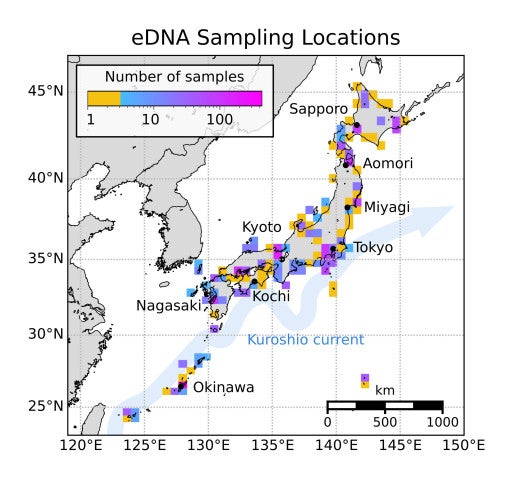
本研究で使用した日本全国のサンプリング地点を示した地図。既存データベースに登録されていた地点と、大島アチュクバシュ博士らが新たに採取したサンプル採取地点が含まれる。© 大島アチュクバシュ博士ほか
<関連情報>
- https://www.oist.jp/ja/news-center/news/2026/10/26/japans-largest-marine-dna-study-detects-126-fish-species-further-north-previously-recorded
- https://onlinelibrary.wiley.com/doi/10.1111/ddi.70281
日本全国規模のeDNA調査によりデータギャップが埋められ、日本各地で新たな生息域外魚類の記録が明らかになった Japan-Wide eDNA Surveys Bridge Data Gaps and Reveal Novel Out-of-Range Fish Records Across Japan
Ayşe Haruka Oshima Açıkbaş, Erina Kawai, Michael Izumiyama, Jeffrey Jolly, Chengze Li, Iori Mizukami, Chloé Julie Loïs Fourreau, Yuka Kushida, Kairi Takahashi, Kohei Hamamoto,…
Diversity and Distributions Published: 26 October 2026
DOI:https://doi.org/10.1111/ddi.70281
Abstract
Aim
Poleward range extensions of marine fishes under climate change are increasingly being reported around the world, but tracking northern latitudinal limits of fish species remains challenging. Occurrence data accumulated from eDNA surveys in Japan could be utilized to detect out-of-range occurrences and track cool leading range edges as fish species shift in response to climate change and other anthropogenic impacts into the future.
Location
Japan EEZ coastlines.
Methods
We analysed a large environmental DNA (eDNA) dataset (2904 marine eDNA samples; 36,247 occurrences for 1290 fish species; 2017–2024) from across Japan, obtained from sampling surveys we conducted along the Eastern Pacific coastlines of Japan and the sequencing datasets on the All Nippon eDNA Monitoring Network (ANEMONE) database, and assessed the latitudinal novelty of the northernmost eDNA occurrence records of species in comparison to existing biogeographical data from three data infrastructures: (1) GBIF/OBIS occurrence records, (2) Aquamaps modelled core habitats, and (3) IUCN expert range maps.
Results
Our analysis identified 126 fish species with eDNA northern limits significantly beyond what is reported by the three reference datasets, including subtropical vagrants potentially overwintering, commercially important species, and small cryptic species. eDNA detected high annual numbers of out-of-range occurrences (maximum 511 vs. IUCN, 1069 vs. Aquamaps) across sampling-intensive years (2020–2022), greater than what is available on GBIF-OBIS, thus complementing traditional methods with improved scalability for distribution range characterization and tracking range edges.
Main Conclusions
This work underscores eDNA’s long-term utility in tracking species redistributions. eDNA occurrence data can fill in the gaps in biogeographical knowledge with its improved scalability for distribution range characterization and tracking range edges. Discrepancies across reference data sources highlight the need for their harmonization and cross-referencing to literature prior to their use as baselines.

