2026-10-26 NASA
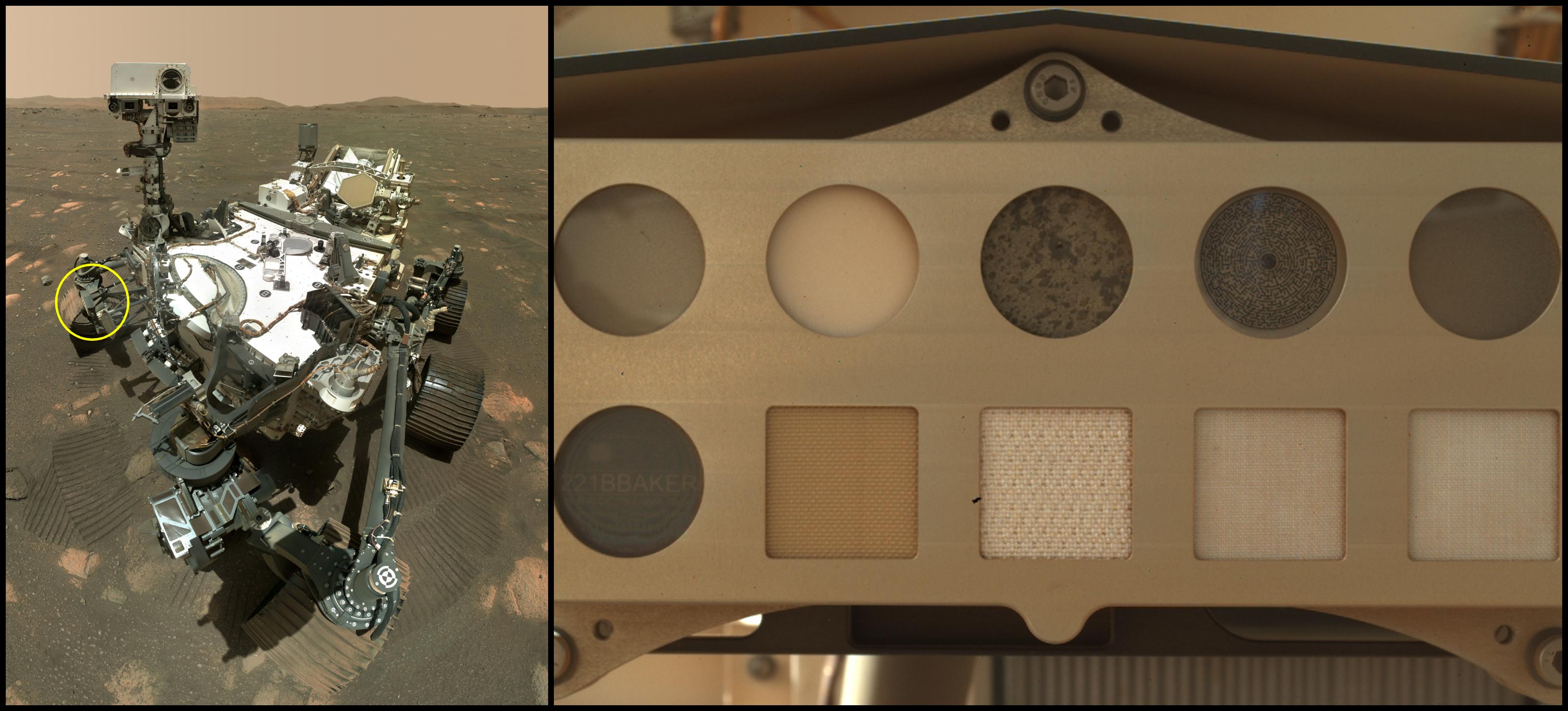
This annotated composite image shows the location on NASA’s Perseverance of the calibration target for rover’s SHERLOC (Scanning Habitable Environments with Raman & Luminescence for Organics and Chemicals) instrument. At right is a close-up of the calibration target. NASA/JPL-Caltech
<関連情報>
- https://www.nasa.gov/missions/mars-2020-perseverance/nasas-perseverance-offers-clues-to-protect-crews-from-mars-dust/
- https://www.pnas.org/doi/10.1073/pnas.2620747123
微細および超微細な火星の塵は、将来の有人火星探査ミッションにとって新たなリスクとなる Fine and ultrafine Martian dust presents additional risks for future crewed missions to Mars
Scott J. VanBommel, Abigail L. Knight, Andrea D. Harrington, +31 , and Álvaro Vicente-Retortillo
Proceedings of the National Academy of Sciences Published:October 26, 2026
DOI:https://doi.org/10.1073/pnas.2620747123
Abstract
Surface dust poses a fundamental challenge to extraterrestrial human exploration, a reality demonstrated by the operational hazards encountered during Apollo lunar missions. On Mars, this challenge is compounded by regional and global dust cycles that coat sensitive hardware. While previous Mars missions have constrained the bulk geochemistry of coarser particulates (≳3 µm), the properties of the fine (≲2.5 µm) and ultrafine (≲0.1 µm) fractions remain largely uncharacterized. This knowledge gap is critical as these respirable particles, defined by their ability to bypass upper respiratory defenses, possess the mobility to penetrate deep into the alveolar regions of biological systems, presenting a systemic toxicity risk to future crews. Here, we report on direct examination of these fine and ultrafine Martian dust fractions using X-ray fluorescence through the analysis and modeling of data acquired by the Perseverance rover. We observe particulates measuring as small as 100 to 200 nm on spacesuit samples and calibration targets. Compositionally, this dust is a phosphorus-, iron-, and sulfur-enriched mafic silicate accumulating on materials analogous to the planned external layers of potential crew systems. Our results emphasize the importance of a thorough characterization of Martian dust properties in terrestrial laboratories to better prepare future crews and crew support systems destined for the surface of Mars.