2026-10-23 神戸大学
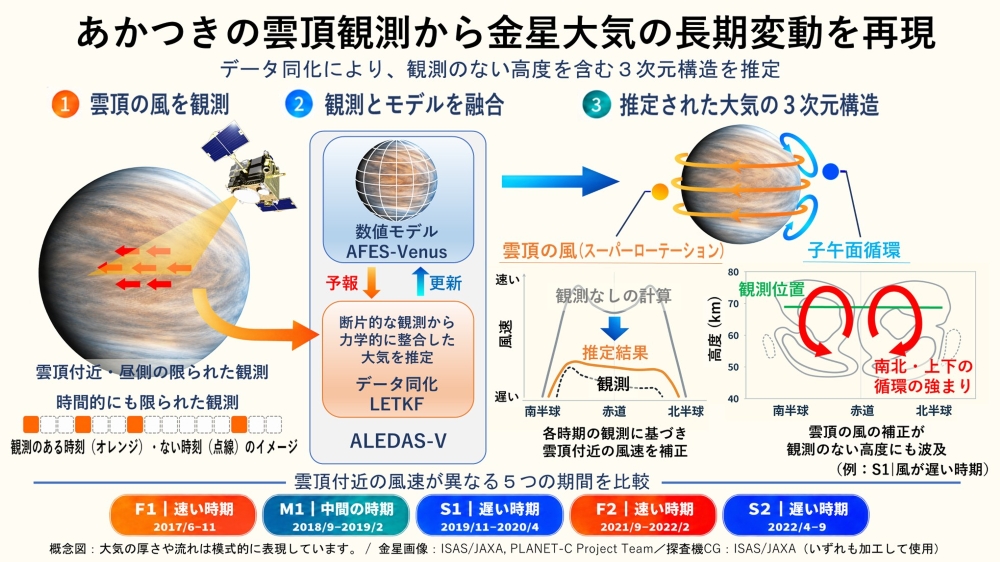
本研究の概念図。雲頂付近・昼側の断片的な観測を数値モデルに取り込み、各時期の雲頂の風を再現するとともに、観測のない高度も含めた大気の3次元構造を推定する。
<関連情報>
- https://www.kobe-u.ac.jp/ja/news/article/20261023-68375/
- https://www.nature.com/articles/s44453-026-00061-w
限られた観測データから金星の長期的な大気循環を再構築する Reconstructing a long-term atmospheric circulation of Venus from sparse observations
Yukiko Fujisawa, Norihiko Sugimoto, Nobumasa Komori, Shin-ya Murakami, Toshiki Matsushima, Hiroki Kashimura, Yasumitsu Maejima, Hiroki Ando, Masahiro Takagi, Takeshi Imamura, Takeshi Horinouchi, George L. Hashimoto, Masaki Ishiwatari, Takeshi Enomoto, Takemasa Miyoshi & Yoshi-Yuki Hayashi
npj Space Exploration Published:23 October 2026
DOI:https://doi.org/10.1038/s44453-026-00061-w
Abstract
The atmospheric superrotation of Venus exhibits pronounced long-term variability and meridional asymmetry, yet its underlying dynamics remain poorly understood because available observations are severely limited in both space and time. Here we apply an existing Venus data assimilation system to multiple 6-month periods spanning distinct superrotation regimes beyond previously investigated intensive observation campaigns. Assimilation of intermittent cloud-top wind observations reproduces the observed long-term variability and meridional asymmetry while systematically modifying three-dimensional atmospheric structures through the model’s internal dynamics. The analyses reveal regime-dependent changes in thermal tides and the mean meridional circulation, reflecting how the model’s internal dynamical balance responds to the constrained cloud-top horizontal winds. The assimilation impact retains atmospheric dynamical memory for up to 1 month during observational gaps before gradually decaying, demonstrating that intermittent observations at the cloud-top level used here are sufficient to constrain the long-term evolution of the Venusian atmosphere. These results establish data assimilation as a powerful framework for reconstructing planetary atmospheric circulation from sparse observations, for maximizing the scientific return of future Venus missions, and enabling new insights into Venus’s dynamic atmosphere.