

2026-10-22 シンガポール国立大学(NUS)
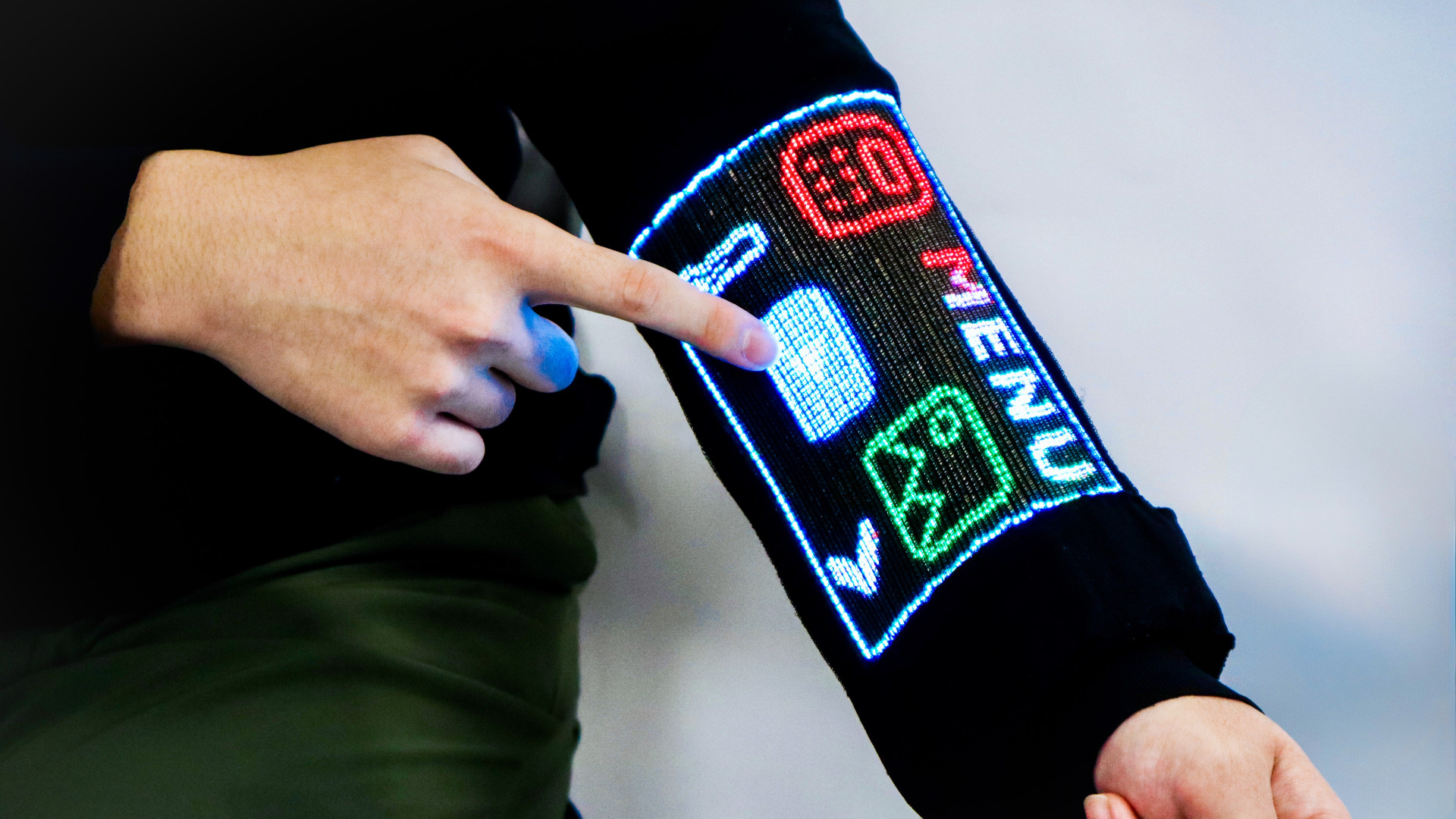
The fibres support the functions early generations of smartphones could perform. The 96 by 54-pixel display can run a calculator, show a photo gallery, play a video, work as a compass, respond to voice commands, receive images over Bluetooth, as well as read and display body temperature.
<関連情報>
- https://news.nus.edu.sg/worlds-first-touchscreen-in-garment/
- https://www.nature.com/articles/s41586-026-11128-9
タッチセンシングデジタルピクセルファイバーにより、インタラクティブな衣服GUIが実現 Touch-sensing digital pixel fibre enables interactive garment GUI
Heng Fu, Ziang Li, Swetika Chaturvedi, Xiaoyu Zhang, Xiaolong Li, Qianyi Li & Tural Khudiyev
Nature Published:21 October 2026
DOI:https://doi.org/10.1038/s41586-026-11128-9
Abstract
Wearable computing promises to transform human interaction with information, yet conventional graphical user interfaces (GUIs) rely on planar, rigid displays incompatible with textiles, which are composed of one-dimensional fibres. Despite recent progress1,2 in flexible and fibre-based displays, bridging this fundamental dimensional mismatch remains challenging because existing approaches do not naturally provide the digitally addressable, high-throughput, information-rich interfaces required for interactive GUIs. Here we present a digital pixel fibre integrating addressable pixels, a common propagation-axis interconnection for scalable in-fibre circuitry and a coaxial sensing layer for fibre-level touch localization. Microelectronic components and a touch-gated resistive path system form a linear circuit that acts as both an interactive display backbone and a computational bus, while peripheral multimodal fibre sensors and actuators enable physiological, inertial, optical, and acoustic input and output. We integrate these fibres into the forearm portion of a garment sleeve to realize a GUI with a 96 × 54-pixel display, 30-frame-per-second refresh rate and 8-bit colour depth. It supports dynamic graphics, integrated audio–video playback, wireless data exchange and interactive computing functions, while maintaining the flexibility, washability, breathability and mechanical robustness of everyday textiles. By merging display, sensing and computation within a single fibre, this work establishes a scalable platform for intrinsically interactive textiles, opening pathways toward garments that operate as fully integrated computational systems.

