2026-09-23 カリフォルニア大学ロサンゼルス校(UCLA)
<関連情報>
- https://newsroom.ucla.edu/releases/eaton-fire-smoke-triggered-airborne-toxins-surge-how-long
- https://pubs.acs.org/aeacd5/article-abstract/doi/10.1021/acsestair.6c00085/5429760/Air-Quality-during-and-after-the-2025-Los-Angeles
2025年ロサンゼルス火災発生時および発生後の大気質と、火災トレーサーとしてのカリウムの有用性 Air Quality during and after the 2025 Los Angeles, California Fires and the Utility of Potassium as a Fire Tracer
Catherine A. Banach;Kyle Caulson;Laura H. Thapa;Pablo E. Saide;Suzanne E. Paulson
ACS ES&T Air Published:September 15, 2026
DOI:https://doi.org/10.1021/acsestair.6c00085
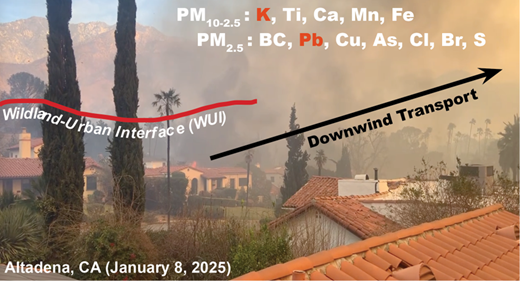
Abstract
Wildland–urban interface fires are becoming more frequent, and their impacts on adjacent urban centers are increasing. In January 2025, the Eaton and Palisades fires burned over 18,000 structures and 15,000 hectares of urban and wildlands and blanketed parts of Southern California, USA, in smoke and dust. Here, we combine hourly and multihour metals, particulate matter, and gas data from two sites with meteorological and fire spatial extent data and several statistical methods to understand the fire impacts on air quality. The primary receptor site, in Huntington Park, about 28 km from the Eaton fire, was intermittently directly downwind. The smoke increased airborne lead concentrations by up to 250 times its background, to about 0.2% of PM2.5 mass; arsenic, chlorine, bromine, and copper were also highly elevated. Concentrations of elements associated with resuspended soil began to rise when high winds started immediately prior to fire ignition and decayed once the winds decreased. Potassium, often used as a biomass-burning tracer, was uncorrelated with smoke. It was strongly associated with coarse particles, and its mass-normalized concentration fell within its normal range during the fires, indicating that potassium cannot be used as a fire tracer in this context. Lead was elevated in smoke throughout the fire, thus, its concentration could not be used to determine urban versus wildland combustion within this WUI fire event. There was no clear tracer of urban vs wildland burning in the smoke or coarse particles. Finally, we found little evidence of fire-associated pollution after the fires had been extinguished.