2026-09-18 北海道大学
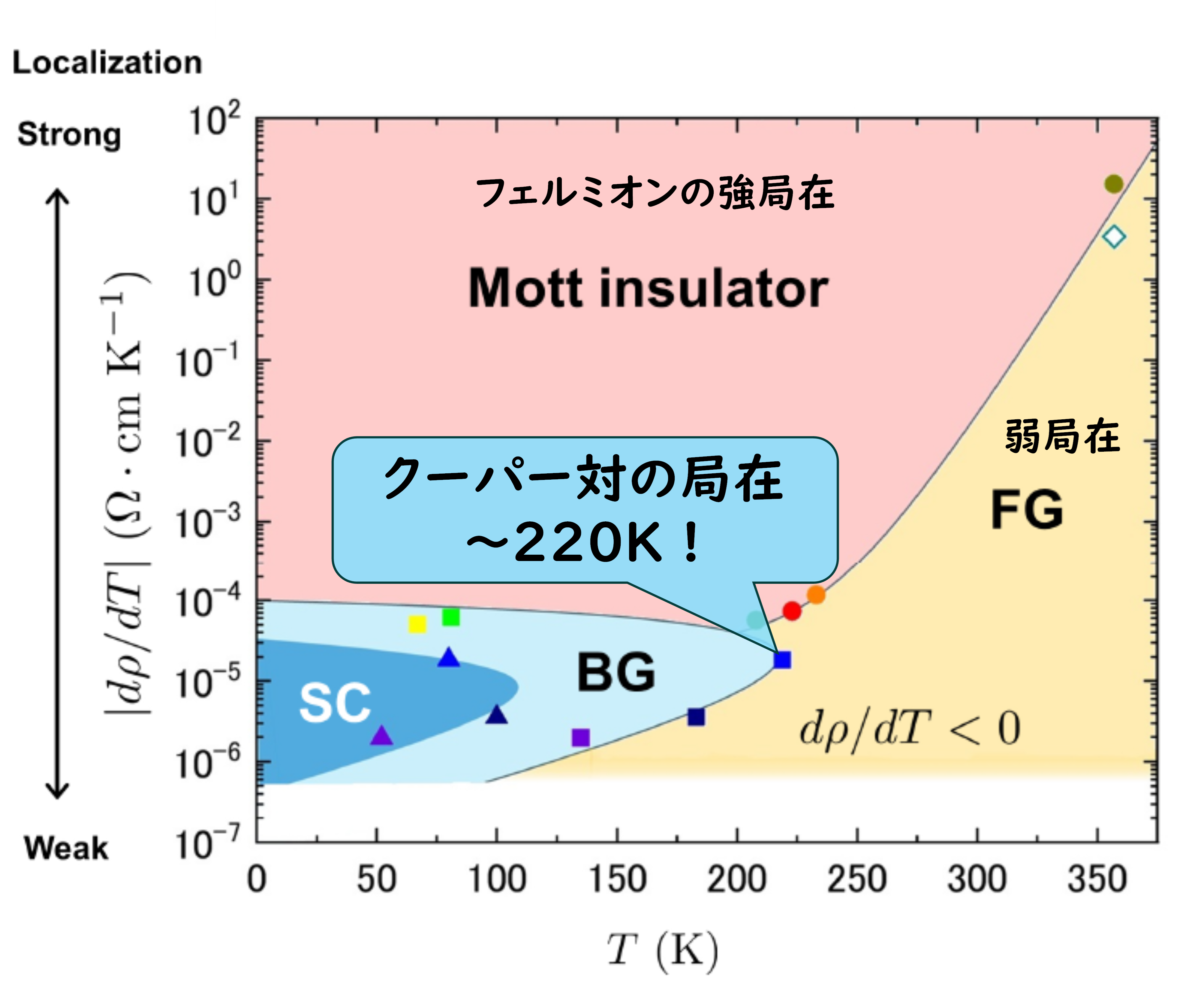
膜厚を制御することで電子相関の強さが変化し、超伝導(SC)、ボースグラス(BG)、フェルミグラス(FG)、モット(Mott)絶縁体の各状態が現れる。ボースグラス相は約220 Kまで広がり、高温で局在したクーパー対の存在を示唆する。
<関連情報>
- https://www.hokudai.ac.jp/news/2026/09/220-k.html
- https://www.nature.com/articles/s43246-026-01325-4
C2RuO4ナノ薄膜におけるボースグラス Bose glass in Ca2RuO4 nanofilms
Hiroyoshi Nobukane, Koki Hirose, Kakeru Isono, Mizuki Higashiizumi, Masahito Sakoda, Korekiyo Takahashi & Satoshi Tanda
Communications Materials Published:10 August 2026
DOI:https://doi.org/10.1038/s43246-026-01325-4
Abstract
Weak localization of bosons can give rise to an exotic quantum state known as a Bose glass, characterized by the absence of global phase coherence yet finite conductivity. Here, we report signatures of a Bose glass state in the weak localization regime of the ruthenium oxide Ca2RuO4 nanofilms. The electrical resistivity exhibits a characteristic logarithmic temperature dependence, ρ ~ ln(1/T), consistent with bosonic weak localization. Furthermore, β-function scaling analysis reveals a distinct “vertical flow,” indicating a qualitative change in scaling behavior associated with localized bosonic transport. These results suggest that signatures of Cooper pairs persist up to high temperatures of ~ 220 K. We identify two quantum critical points associated with changes in scaling behavior between the Bose glass and superconducting regimes, and between the Bose glass and strongly localized regimes. We demonstrate that the ground state is governed by the strength of localization arising from the interplay of electron correlation, lattice distortion of the RuO6 octahedra, and reduced dimensionality, where film thickness acts as an effective control parameter. These findings establish Ca2RuO4 nanofilms as a platform for exploring bosonic localization in strongly correlated oxides, with implications for cuprates and nickelates.