2026-09-17 マウントサイナイ医療システム(MSHS)
<関連情報>
- https://www.mountsinai.org/about/newsroom/2026/wildfire-smoke-may-be-more-harmful-than-other-air-pollution-two-mount-sinai-studies-find
- https://www.nature.com/articles/s41467-026-76974-7
- https://www.sciencedirect.com/science/article/pii/S1470204526002950
米国20州における山火事特有のPM2.5および山火事以外のPM2.5による心肺疾患入院リスク Cardiopulmonary hospitalization risks from wildfire-specific and non-wildfire PM2.5 in 20 US states
Min Zhang (张敏), Edgar Castro, Minghao Qiu, Mahdieh Danesh Yazdi, Boyuan Li, Rosalind J. Wright, Joel D. Schwartz, Robert O. Wright & Yaguang Wei
Nature Communications Published:17 September 2026
DOI:https://doi.org/10.1038/s41467-026-76974-7
Abstract
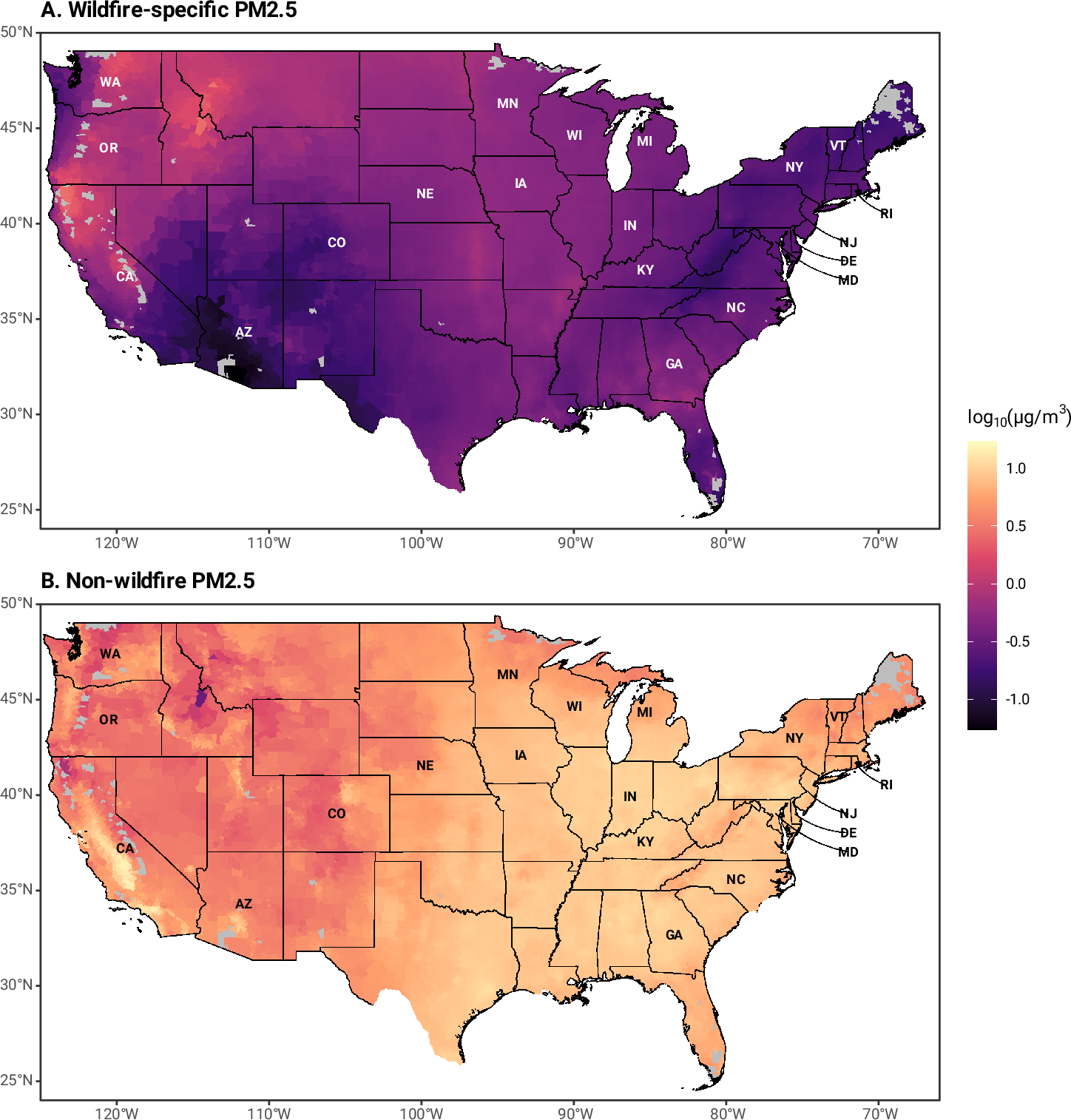
Increasing wildfire activity in the US has made wildfire-specific fine particulate matter (PM2.5) an important and growing source of air pollution, yet its long-term health impacts and relative toxicity compared with non-wildfire PM2.5 remain unclear. Using a self-controlled design, we examine associations between 2-year average wildfire-specific and non-wildfire PM2.5 and cardiopulmonary hospitalization risks across 20 US states during 2006–2019. Per 1 µg/m3 increase, wildfire-specific PM2.5 is associated with significantly higher hospitalization risks for all cardiopulmonary diseases, with relative risks ranging from 10% for heart failure to 16% for asthma. In contrast, a 1-µg/m3 increase in non-wildfire PM2.5 is associated with smaller risk elevations, ranging from 4.7% for chronic obstructive pulmonary disease to 8.5% for hypertension. Stronger associations for both wildfire-specific and non-wildfire PM2.5 are observed among minorities, metropolitan residents, those with fewer years of education, and more deprived communities. Overall, at an equivalent concentration increase, long-term exposure to wildfire-specific PM2.5 poses greater cardiopulmonary hospitalization risks than non-wildfire PM2.5, underscoring wildfire smoke as a growing public health threat that requires targeted mitigation alongside conventional air quality control strategies.
山火事由来のPM2.5への長期曝露と高齢肺がん患者の全生存率:後向き登録データに基づくコホート研究 Long-term exposure to wildfire-related PM2·5 and overall survival of older patients with lung cancer: a retrospective, registry-based cohort study
Min Zhang PhD, Prof Juan P Wisnivesky MD DrPH, Minghao Qiu PhD, Mahdieh Danesh Yazdi PhD, Kanhua Yin MD MPH, Prof Rosalind J Wright MD MPH, Prof Joel D Schwartz PhD, Christine C Ekenga PhD MPH, Prof Robert O Wright MD MPH, Yaguang Wei PhD
The Lancet Oncology Available online: 15 September 2026
DOI:https://doi.org/10.1016/S1470-2045(26)00295-0
Summary
Background
Fine particulate matter (PM2·5) has been identified as a key risk factor for lung cancer incidence and survival. PM2·5 from wildfire smoke is an increasingly important contributor to total PM2·5 in the USA, driven by climate change, and potentially more toxic than non-wildfire PM2·5 due to its smaller particle size and higher toxic contents. However, the effects of wildfire-related PM2·5 on the overall survival of patients with lung cancer remain unclear.
Methods
This retrospective cohort study included patients aged 65 years or older with histologically confirmed primary small-cell lung cancer or non-small-cell lung cancer (as defined by the International Classification of Diseases for Oncology, Third Edition) from the Surveillance, Epidemiology, and End Results (SEER)-Medicare database between Jan 1, 2006, and Dec 31, 2019, for whom residential zip code-based estimates of wildfire-related PM2·5 and non-wildfire PM2·5 were available. Individuals diagnosed at the in situ stage, without continuous enrolment in Medicare Parts A and B, or with missing exposure or covariate data were excluded. Participants were followed up annually from diagnosis until death, loss to follow-up, or the end of the study in 2019, whichever came first. Daily estimates of ambient wildfire-related PM2·5 and total PM2·5 across the contiguous USA (from 2006 to 2019) were obtained from previously developed and validated models and spatially aggregated to zip code level. Non-wildfire PM2·5 was calculated as the difference between total PM2·5 and wildfire-related PM2·5, and negative values were excluded. The main outcome was all-cause mortality. A time-varying Cox proportional hazards model was applied to estimate the primary exposure of interest of the long-term effects of 3-year moving averages of wildfire-related PM2·5 and non-wildfire PM2·5 concentrations on overall survival.
Findings
Between Jan 1, 2008, and Dec 31, 2019 (the analysis period), 414 016 patients with lung cancer contributed 1 211 490 person-years of follow-up, with a median follow-up of 2 years (IQR 1–4). Of these, 208 468 (50·4%) patients were female, 205 548 (49·6%) were male, 356 356 (86·1%) were White, 36 914 (8·9%) were Black, 18 982 (4·6%) were Asian or Pacific Islander, and 1269 (0·3%) were American Indian or Alaska Native; race or ethnicity was unknown for 495 patients (0·1%). The median concentrations of PM2·5 were 0·28 μg/m3 (IQR 0·21–0·39) for wildfire-related PM2·5 and 8·11 μg/m3 (6·84–9·47) for non-wildfire PM2·5. Each 1-SD increase in wildfire-related PM2·5 or non-wildfire PM2·5 was associated with an increased risk of death for patients with lung cancer (HR 1·0229, 95% CI 1·0189–1·0270; p<0·0001 for wildfire-related PM2·5 and HR 1·0384, 1·0335–1·0432; p<0·0001 for non-wildfire PM2·5). The HR per 1-μg/m3 increase in PM2·5 concentration was 1·0782 (1·0641–1·0924; p<0·0001) for wildfire-related PM2·5 and 1·0171 (1·0149–1·0192; p<0·0001) for non-wildfire PM2·5. Overall, 696 (95% CI 576–814) average annual excess deaths in this cohort were attributable to wildfire-related PM2·5 and 3465 (3061–3864) were attributable to non-wildfire PM2·5.
Interpretation
Wildfire-related PM2·5 showed greater toxicity per unit exposure than non-wildfire PM2·5. As wildfire-related PM2·5 is the fastest-growing contributor to ambient air pollution, there is an urgent need for updated strategies to manage wildfires and mitigate their effects.
Funding
National Institute of Environmental Health Sciences, National Cancer Institute, National Institutes of Health, National Center for Advancing Translational Sciences, Centers for Disease Control and Prevention’s National Program of Cancer Registries, and Stony Brook University.