

2026-09-08 アルゴンヌ国立研究所(ANL)
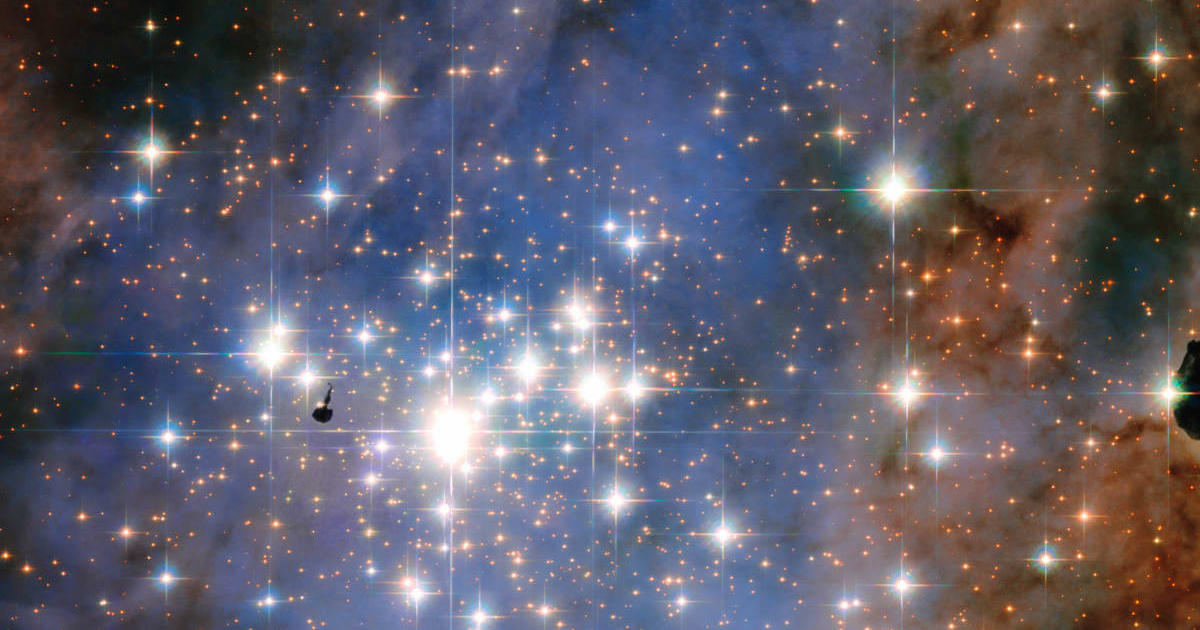
This image features the star cluster Trumpler 14, one of the largest gatherings of hot, massive and bright stars in the Milky Way. (Representative Cover Image Source: NASA & ESA, Jesús Maíz Apellániz (Instituto de Astrofisica de Andalucia))
<関連情報>
- https://starlust.org/what-happens-when-a-star-dies-new-research-gets-closer-to-an-answer/
- https://journals.aps.org/prl/abstract/10.1103/gbbj-hpqk
- https://journals.aps.org/prl/abstract/10.1103/9zv2-wlkl
不安定な単一核子転送59Cu天体物理学的X線バーストにおけるNiCuサイクルの探査 Single-Nucleon Transfer on Unstable 59Cu Probes the NiCu Cycle in Astrophysical X-Ray Bursts
C. O’Shea, G. Lotay, A. Gade, D. T. Doherty, H. Schatz, J. S. Randhawa, B. A. Brown, D. Weisshaar, J. Pereira et al.
Physical areviw Letters Published: 6 July, 2026
DOI: https://doi.org/10.1103/gbbj-hpqk
Abstract
Recent models of the rapid proton () capture process indicate that a competition between the 59Cu(,)60Zn and 59Cu(,)56Ni reactions may result in the formation of a nickel-copper (NiCu) cycle that traps the flux of material between 56Ni and 60Zn. Here, we report the identification of 15 proton-unbound levels in 60Zn, populated via 59Cu(,) transfer, which govern the rate of the 59Cu(,)60Zn reaction in XRBs. Precise excitation energies for levels in 60Zn were obtained from observed decays, and spectroscopic factors were determined from angle-integrated cross sections. Incorporating these results into stellar-model calculations, we find that with experimentally constrained uncertainties a NiCu cycle in XRBs is indeed possible, though we limit its branching strength to less than 38%. While modest, such a branching has significant impact on the light curve, motivating further studies of the relevant rates. Our calculations also indicate that a significant NiCu cycle leads to an increase in the amount of odd- nuclei in the burst ashes, which may affect Urca cooling processes in neutron star crusts.
45V(p,γ)46Cr反応における共鳴状態の同定と、それらがコア崩壊型超新星における44Ti生成に及ぼす影響 Identification of Resonant States in the 45V(,)46Cr Reaction and Their Influence on the Production of 44Ti in Core-Collapse Supernovae
C. Cousins, G. Lotay, D. T. Doherty, D. Seweryniak, C. Sarma, C. M. Campbell, L. Canete, M. P. Carpenter, W. N. Catford et al.
Physical Review Letters Published: 23 June, 2026
DOI: https://doi.org/10.1103/9zv2-wlkl
Abstract
The observation of active 44Ti in supernova remnants offers the potential to solve one of the most debated questions in modern astrophysics, the exact underlying explosion mechanism of core collapse supernovae (CCSNe). In particular, a comparison between the predicted synthesized yield of 44Ti and the ejected flux is expected to allow for a determination of the mass cut of the star. Unfortunately, such comparisons are currently severely hindered by large uncertainties in the nuclear reactions governing the production and destruction of 44Ti. On this note, the astrophysical 45V(,)46Cr reaction is expected to play a decisive role. We present the first experimental information on resonant states in the 45V(,)46Cr reaction. Excitation energies have been measured with high precision for ten previously unknown, low-spin, proton-unbound states in 46Cr, and spin-parity-assignment constraints have been made using observed -decay patterns and shell-model calculations. We find that an ℓ =1 resonance at 714 keV dominates the 45V(,)46Cr reaction for the entire temperature range of -rich freezeout. Moreover, the nominal rate is found to be ∼25–50% of previous estimates for >1.2 GK, indicating an increase in 44Ti production in CCSNe of ∼20–35%.

