2026-09-16 カリフォルニア大学リバーサイド校(UCR)
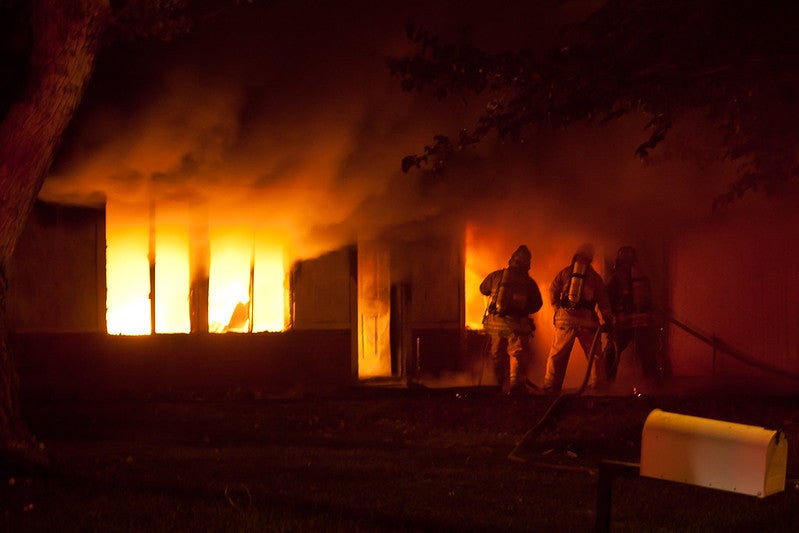
Firefighters battling a domestic blaze. (Ada Be)
<関連情報>
- https://news.ucr.edu/articles/2026/09/16/rich-neighborhoods-more-likely-burn
- https://www.nature.com/articles/s42949-026-00455-5
米国における都市部をまたぐ火災における焼失面積の増加と生態系回復の不均衡 Increasing burned area and unequal ecological recovery in U.S. urban-intersecting fires
Dion Kucera & G. Darrel Jenerette
npj Urban Sustainability Published:04 August 2026
DOI:https://doi.org/10.1038/s42949-026-00455-5 Early Provide
Abstract
Wildfires intersecting developed land cover are a growing urban disturbance, yet national evidence on their frequency, ecological impacts, and social distribution remains limited. Using 141 U.S. urban-intersecting fires (1984–2025), we integrated fire perimeters, Landsat-derived NDVI and land-surface temperature, hydroclimate records, and census data. Annual fire counts did not increase, whereas burned area for larger events rose 0.22 km² yr⁻¹ (conventional p = 0.035; heteroskedasticity-robust p = 0.058), a positive trend sensitive to variance assumptions and to a few extreme fire years. Residents of fire-exposed tracts grew from 2.06 to 2.80 million despite stable per-capita exposure. Fires were preceded by short-term drying rather than long-term deficits, with wet-to-dry hydroclimate whiplash in 41–43% of events. High-severity pixels showed median NDVI declines of 41% and land-surface temperature increases of 2.35 °C, and 73% and 78% failed to recover greenness and temperature, respectively, within five years. Exposure concentrated in lower-density, owner-occupied, higher-income tracts, yet thermal recovery was faster in wealthier neighborhoods, revealing a two-stage inequality in who burns and who recovers. Because these dynamics are not unique to the United States, our framework transfers to fire-prone urban regions with comparable satellite and demographic records.