2026-08-26 琉球大学
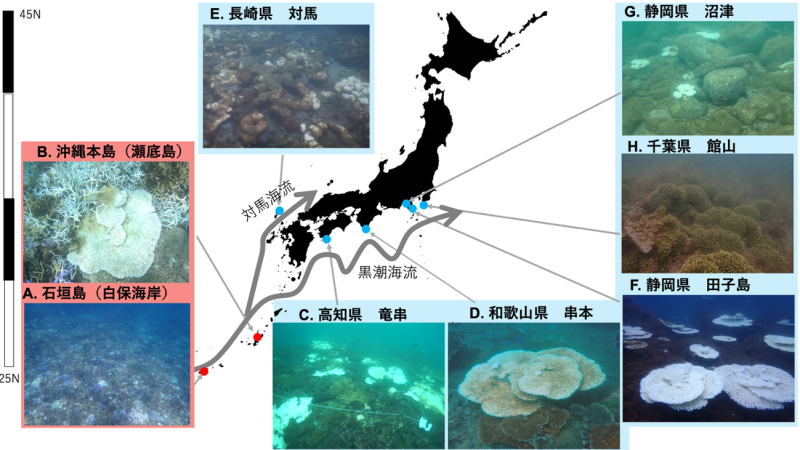
図1 2024年日本列島を襲った海洋熱波は沖縄本島や石垣島のサンゴ礁域に加えて、高知県竜串、和歌山県串本、長崎県対馬、静岡県の田子島および沼津地域で全国的なサンゴの大規模な白化が観測された。
<関連情報>
記録的な海洋熱ストレスにより、亜熱帯および温帯の日本全域でサンゴの白化が広範囲に発生 Widespread coral bleaching across subtropical and temperate Japan under record marine heat stress
Haruko Kurihara,Hiroya Yamano,Kohsaku Yokoyama,Sayaka Yasunaka,Nina Yasuda,Chuki Hongo,Masako Nakamura & Teruki Nagamine
Scientific Reports Published:25 August 2026
DOI:https://doi.org/10.1038/s41598-026-65095-2
Abstract
Marine heatwaves in 2024 drove record-breaking sea surface temperatures (SSTs) across the Japanese coast, generating the highest Degree Heating Weeks (DHW), which quantifies the accumulation of thermal stress, observed in the past four decades. Here, we quantify thermal stress and coral bleaching responses across a latitudinal gradient spanning subtropical reef systems and non-reef temperate regions (24°–35°N). DHW exceeded 8 °C-weeks at all sites and reached extreme levels of 17–19 °C-weeks at high latitudes. This unprecedented heat stress triggered widespread mass coral bleaching across both subtropical and temperate regions, with bleaching prevalence reaching 55–95% at most temperate sites. Severe bleaching was recorded not only at well-established subtropical reef but also at marginal temperate communities, including the first documented event at Tsushima and consecutive bleaching events at previously unaffected sites. Notably, poleward-expanding Acropora species exhibited near-complete bleaching, demonstrating that recently established high-latitude populations remain highly vulnerable to extreme thermal stress. Bleaching susceptibility in corals was also found to be species- and site-specific. Strikingly, no bleaching was observed at Tateyama despite high DHW, underscoring the importance of local thermal thresholds and environmental context, and highlighting limitations of DHW as a predictor in temperate regions. Our results demonstrate that extreme ocean warming can drive severe and widespread coral bleaching beyond tropical reef boundaries, affecting both endemic and poleward-expanding coral assemblages. These findings challenge the paradigm that temperate regions function as climate refugia and suggest that the pace of ongoing climate change may outstrip the capacity of corals to adapt or shift their distributions.