2026-08-25 東北大学
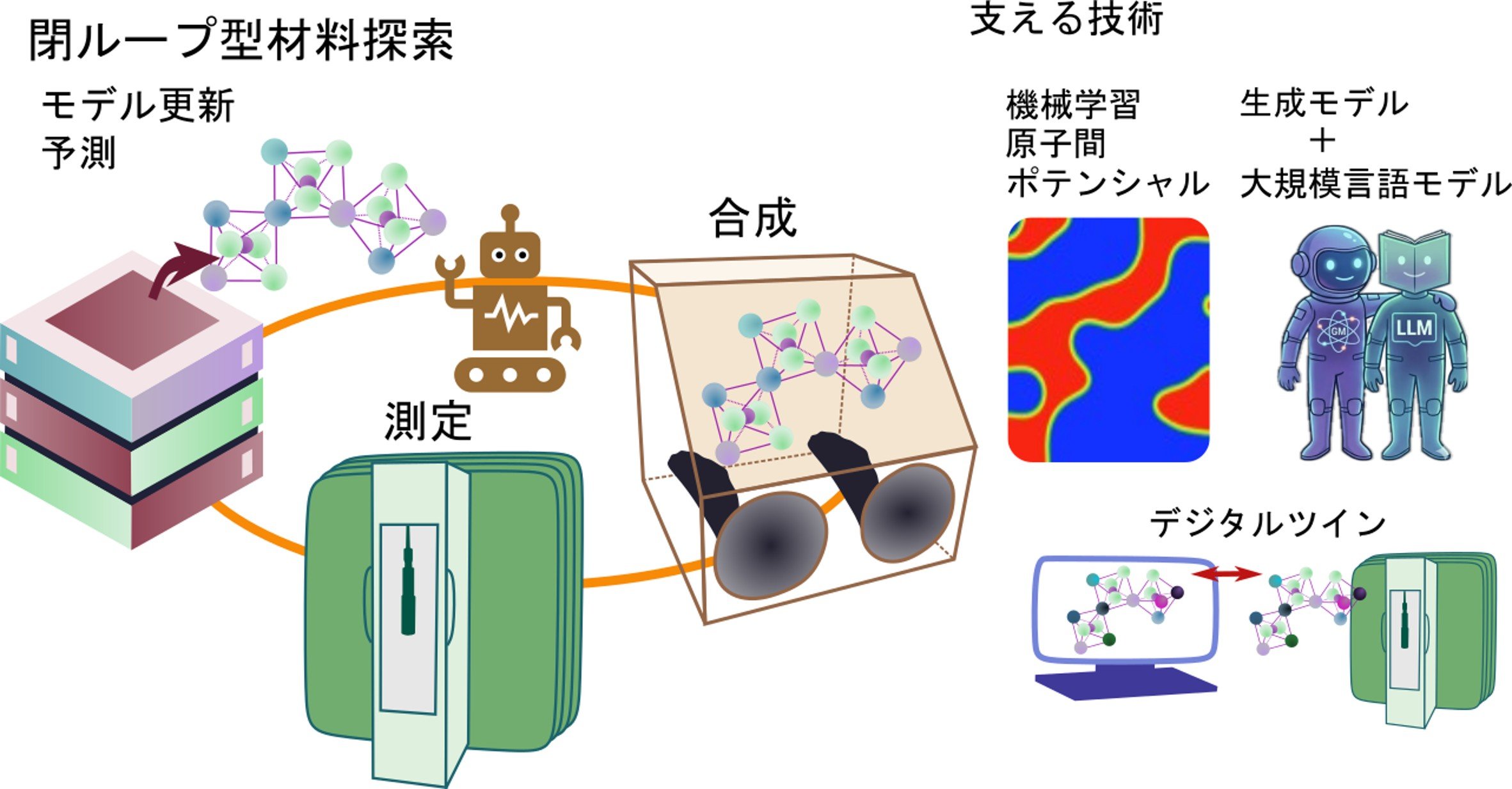
図1. 本論文が提案する水素貯蔵材料探索の全体像。データベース、物理法則を組み込んだモデル、AIによる候補設計、自動化実験、デジタルツインを循環させ、予測と実験を相互に更新します。
<関連情報>
- https://www.tohoku.ac.jp/japanese/2026/08/press20260825-03-AI.html
- https://pubs.acs.org/aelccp/article/doi/10.1021/acsenergylett.6c01856/5255294/Building-a-Physics-Aware-AI-Ecosystem-for-Solid
固体水素貯蔵材料のための物理法則を考慮したAIエコシステムの構築 Building a Physics-Aware AI Ecosystem for Solid-State Hydrogen Storage Materials
Seong-Hoon Jang;Yiwen Yao;Chuanyu Liu;Linda Zhang ;Di Zhang;Xue Jia;Hung Ba Tran;Eric Jianfeng Cheng;Ryuhei Sato;Yusuke Ohashi;Toyoto Sato;Yusuke Hashimoto;Mark D. Allendorf;Nongnuch Artrith;Marcello Baricco;Andreas Borgschulte;Darren P. Broom;Ang Cao;Benjamin Wei Jie Chen;Lixin Chen;Ping Chen;Eun Seon Cho;Stefano Deledda;Zhao Ding;Martin Dornheim;Michael Felderhoff;Yaroslav Filinchuk;George E. Froudakis;Mingxia Gao;Thomas Gennett;Zaiping Guo;Ikutaro Hamada;Jason Hattrick-Simpers;Bjørn C. Hauback;Michael Hirscher;Torben R. Jensen;Baohua Jia;Hyoung Seop Kim;Takahiro Kondo;Kentaro Kutsukake;Xiao-Yan Li;Tongliang Liu;Piao Ma;Jianfeng Mao;Rana Mohtadi;Hyunchul Oh;Mark Paskevicius;Chris J. Pickard;Astrid Pundt;Anibal J. Ramirez-Cuesta;Hiroyuki Saitoh;Kaihang Shi;Aloysius Soon;Chenghua Sun;Chris Wolverton;Hiroshi Yabu;Weijie Yang;Zhenpeng Yao;Xuebin Yu;Jianxin Zou;Shouyi Hu;Panpan Zhou;Xi Lin;Zhigang Hu;Zhenhao Zhou;Pengfei Ou;Jiayu Peng;Shin-ichi Orimo ;Hao Li
ACS Energy Letters Published:August 14, 2026
DOI:https://doi.org/10.1021/acsenergylett.6c01856
Abstract
Hydrogen storage remains a central bottleneck for scalable hydrogen energy systems due to the multiscale and coupled nature of the thermodynamics, kinetics, and microstructural evolution of hydrogen storage materials (HSMs). Although artificial intelligence (AI) has accelerated materials discovery, current approaches remain constrained by fragmented data, limited physical consistency, and weak integration with experimental validation. Here, we propose a unified framework that integrates coherent data infrastructure, physics-grounded modeling, and AI-driven inverse design within a closed-loop discovery paradigm. By constraining optimization with thermodynamics, kinetics, uncertainty, provenance, and experimental feedback, this approach enables adaptive, physically consistent optimization, thereby establishing a pathway toward autonomous, digital-twin-enabled discovery of HSMs.