
2026-08-21 ペンシルベニア州立大学(Penn State)
<関連情報>
- https://www.psu.edu/news/research/story/hidden-stars-suggest-distant-galaxies-are-more-massive-they-appear
- https://www.nature.com/articles/s41550-026-02932-4
初期銀河における隠された質量は、底辺が重い初期質量関数によって明らかになった Hidden mass in early galaxies revealed by bottom-heavy initial mass functions
Chloe M. Cheng,Martje Slob,Mariska Kriek,Aliza G. Beverage,Pieter G. van Dokkum,Rachel Bezanson,Gabriel Brammer,Charlie Conroy,Anna de Graaff,Elham Eftekhari,Robert Feldmann,Wout M. Goesaert,Meng Gu,Joel Leja,Brian Lorenz,Pavel E. Mancera Piña,Ignacio Martín-Navarro,Andrew B. Newman,Sedona H. Price,Alice E. Shapley,Piyush Sharda,Katherine A. Suess,Arjen van der Wel & Daniel R. Weisz
Nature Astronomy Published:18 August 2026
DOI:https://doi.org/10.1038/s41550-026-02932-4
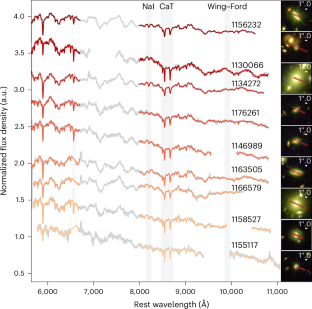
Abstract
James Webb Space Telescope (JWST) observations have revealed that massive galaxies formed and evolved faster than predicted by galaxy formation models, with many having already assembled a large mass in stars approximately 12 billion years ago. However, masses of distant galaxies are uncertain, as they assume a distribution of stellar birth masses (the initial mass function (IMF)) similar to that in the Milky Way. Specifically, the contribution from low-mass stars, which make up the bulk of stellar mass, is not directly observed but inferred on the basis of an extrapolation of the Milky Way IMF. Here, we provide robust constraints on the low-mass IMF beyond the local Universe from full-spectrum models. Using ultra-deep spectra of nine massive quiescent galaxies at redshift z ≈ 0.7 from the JWST Initial Mass Function of Early Red NIRSpec Objects program, extended to bluer wavelengths with deep Very Large Telescope Large Early Galaxy Astrophysics Census spectra, we find that the most massive galaxies have excess low-mass stars. Remarkably, our oldest galaxy (formation redshift, zform > 5) has the most bottom-heavy IMF. This galaxy may be a descendant of JWST’s ‘impossibly early’ galaxies, implying that the latter may have had similarly bottom-heavy IMFs, increasing their masses by a factor of approximately 4 ± 1. Our findings may thus amplify the tension with galaxy formation models.

