2026-08-19 京都大学
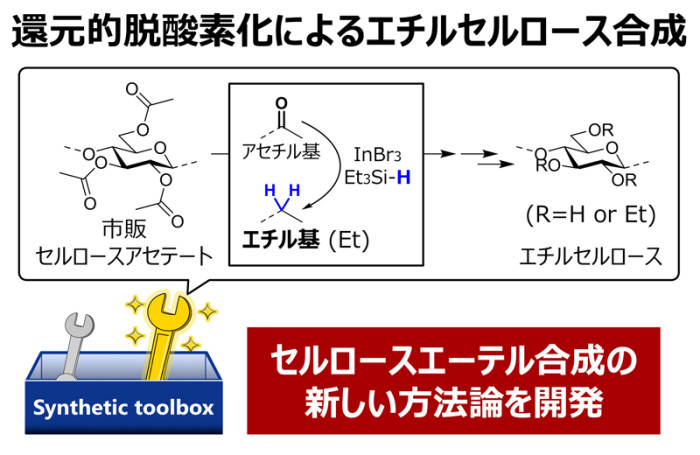
本研究の概要(作成:佐藤佑樹)
<関連情報>
- https://www.kyoto-u.ac.jp/ja/research-news/2026-08-19-3
- https://www.sciencedirect.com/science/article/pii/S0144861726008672
⾦属触媒を⽤いた市販セルロースアセテートの還元的脱酸素化による6位優先的置換エチルセルロースの合成と性質 Synthesis and properties of ethyl cellulose preferentially substituted at C6 position via metal-catalyzed reductive deoxygenation of commercial cellulose triacetate
Yuuki Sato, Naotaka Nishio, Hiroshi Kamitakahara
Carbohydrate Polymers Available online: 10 August 2026
DOI:https://doi.org/10.1016/j.carbpol.2026.125750
Abstract
This study describes a novel method for synthesizing ethyl cellulose (EC) via the metal-catalyzed reductive deoxygenation of commercial cellulose triacetate (CTA). Herein we explore suitable combinations of group 13 metal catalysts and hydrosilanes that enable the conversion of acetyl groups on CTA to ethyl groups, followed by the characterization and functional analysis of the resulting EC. The combination of InBr3 and triethylsilane successfully reduced CTA with various molecular weights, affording EC derivatives with ethyl, acetyl, and triethylsilyl substituents. The removal of the acetyl and triethylsilyl groups yielded water-soluble ECs with a degree of substitution of ethyl groups between 0.5 and 0.7. NMR analyses revealed that the reductively synthesized ECs unexpectedly had ethyl groups preferentially substituted at the C6 position (≈60%), contrary to EC synthesized by the SN2 reaction, which show preferential ethylation at the C2 position. Moreover, the ECs obtained via reduction exhibited different aggregation behaviors in aqueous solutions from those synthesized via nucleophilic substitution. These results indicate that the reductive deoxygenation of CTA affords EC with a substitution pattern distinct from that of conventionally synthesized ones, leading to unique functions. This study paves the way for a new synthetic paradigm that expands structural and functional diversity of cellulose ethers.