2026-08-18 東北大学
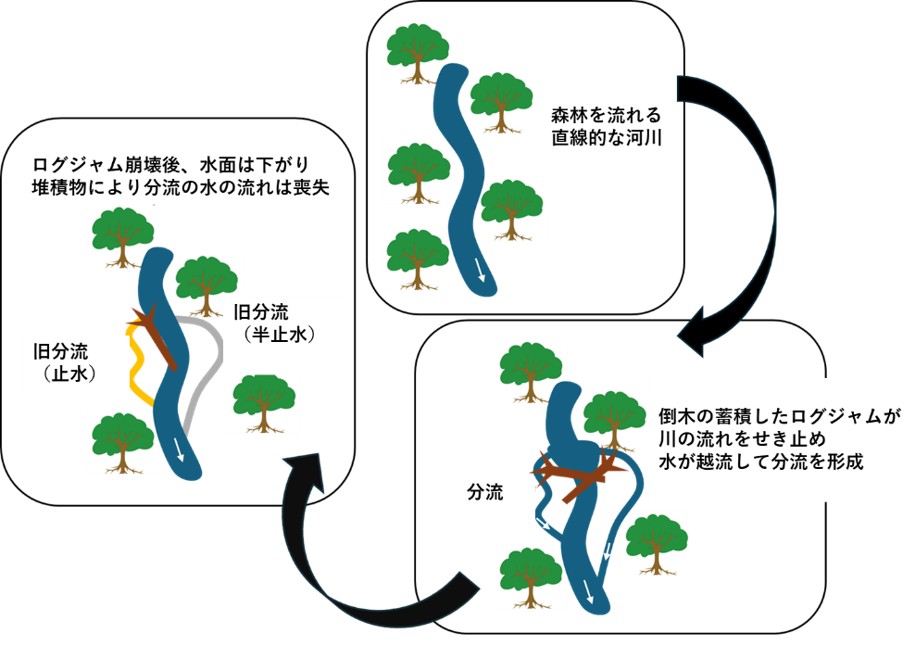
図1. 倒木と川の形・水の流れの関係。渓畔林からの倒木が川の地形を複雑化して複数の流路を形成、流路変更に伴い形成される旧流路(河跡湖)がたまりや池となって多様な水辺を形成する。
<関連情報>
- https://www.lifesci.tohoku.ac.jp/research/results/detail—id-53416.html
- https://esajournals.onlinelibrary.wiley.com/doi/10.1002/ecs2.70700
大きな木々は、水文学的に変動する氾濫原環境と水生生物の多様性を支える Large wood supports hydrologically variable floodplain environments and aquatic biodiversity
Hiromi Uno, Junjiro Negishi, Kentaro Morita, Osamu Kishida, Ellen Wohl
Ecosphere published: 12 August 2026
DOI:https://doi.org/10.1002/ecs2.70700
Abstract
Riparian vegetation and wood play crucial roles in enhancing spatial heterogeneity in rivers. Historical removal of large wood and cutting of streamside forests around the world have simplified rivers and substantially reduced aquatic habitat complexity. To understand how natural rivers sustain geomorphic and hydrologic complexity and support aquatic diversity, we carried out an interdisciplinary field study in a stream flowing through a natural forest in Hokkaido, Japan. We mapped a total of 631 large wood pieces, including 77 log jams, as well as 65 side channels (total 10.1 km) along a 9.2-km length of the main channel. More avulsions (channel divergence) and side channels were present in stream sections with a greater density of large wood and logjams. At flood stage, 90% of the side channels were inundated with through-flowing river water, while the other 10% remained disconnected from the main channel and harbored stagnant water. At base flow, only 20% of the side channels had flow from the mainstem river, 46% contained stagnant water, and 34% were dry. The cumulative areas of permanent, transient, and disconnected side channels were 20%, 9%, and 6% of the main channel area, respectively. We estimated the contribution of each habitat type with different hydrological regimes to the entire population of aquatic animals in the study area. The analysis demonstrated that 4 out of 11fish taxa, 5 out of 26 benthic macroinvertebrate taxa, 3 out of 3 plankton taxa, and 2 out of 2 amphibian taxa primarily utilized transient or disconnected channels. Furthermore, cohort analysis of the dominant fish Salvelinus leucomaenis showed that they exhibit ontogenetic habitat shifts from channels with transient flow as juveniles to channels with permanent flow, indicating the need for both types of habitats and for connectivity between these habitats. Our results demonstrate forms and processes characteristic of the mostly lost and forgotten baseline of rivers in Japan; how geomorphologically and hydrologically complex a natural river can be; and how aquatic organisms rely on such complexity. Large wood potentially plays important roles in sustaining such complexity, and further studies should investigate these mechanisms.