2026-08-11 ロッキーズ国立研究所(NLR)
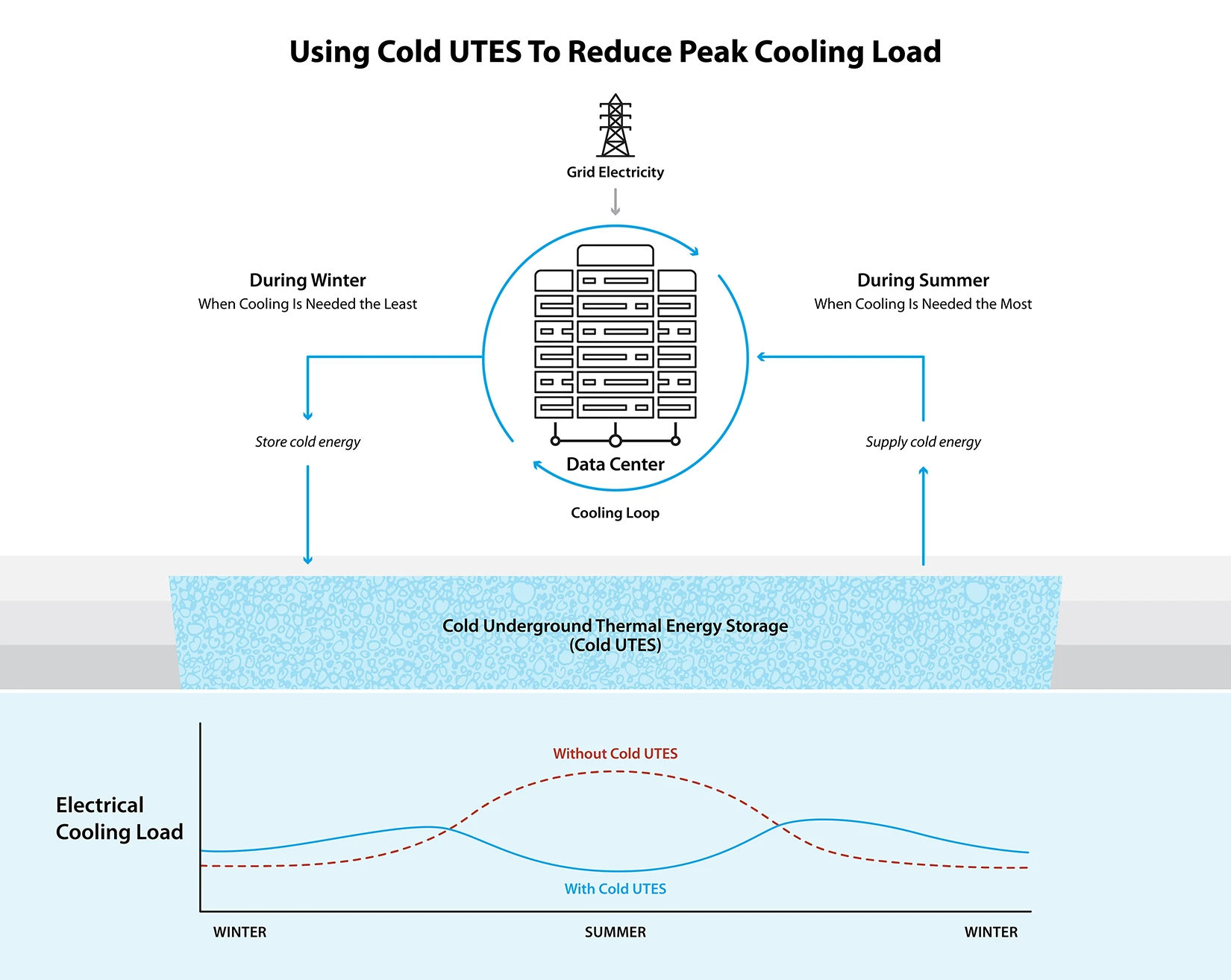
During off-peak hours, cold UTES works by using the spare cooling capacity of a cooling system. Cold thermal energy is then discharged from the UTES during peak hours—such as in the summer—to allow high-electric-use chillers to be turned off. Figure by Dominique Barnes, National Laboratory of the Rockies
<関連情報>
- https://www.nlr.gov/news/detail/program/2026/computing-facilities-can-save-big-and-keep-cool-by-looking-underground
- https://docs.nlr.gov/docs/fy26osti/100780.pdf
プロジェクト第1フェーズ報告書:地下低温熱エネルギー貯蔵(Cold UTES)を活用したデータセンターのピーク冷却需要およびエネルギーコストの削減 Project Phase 1 Report: Reducing Data Center Peak Cooling Demand and Energy Costs With Cold Underground Thermal Energy Storage (Cold UTES)
Josh McTigue, Wesley Cole, Hyunjun Oh, Rebecca Barney, Erik Witter, Abra Gold, Claire Halloran, Sarah Smith, Milica Grahovac, Mohan Ganeshalingam, Andrew A Chien, Wedan Emmanuel Gnibga, Jesse Jenkins, Qian Luo, Dasun Perera, Greg Schivley, Jeff Winick, Kevin Kitz, Lindsey Baker, Guangdong Zhu
National Laboratory of the Rockies Published:June 2026
Executive Summary
This report describes a U.S. Department of Energy (DOE) Office of Geothermal-funded project to investigate how data center cooling loads can be managed by Cold Underground Thermal Energy Storage (Cold UTES). The project was led by the National Laboratory of the Rockies (NLR) in collaboration with Lawrence Berkeley National Laboratory (LBNL), the University of Chicago, Princeton University, and industrial advisors. Several modeling methodologies were used to encompass a range of modeling techniques and assumptions. The intent of this work is to describe the methods and results of the analyses and provide a broad consensus on the value and opportunity for Cold UTES for data center cooling.