2026-07-24 東京大学
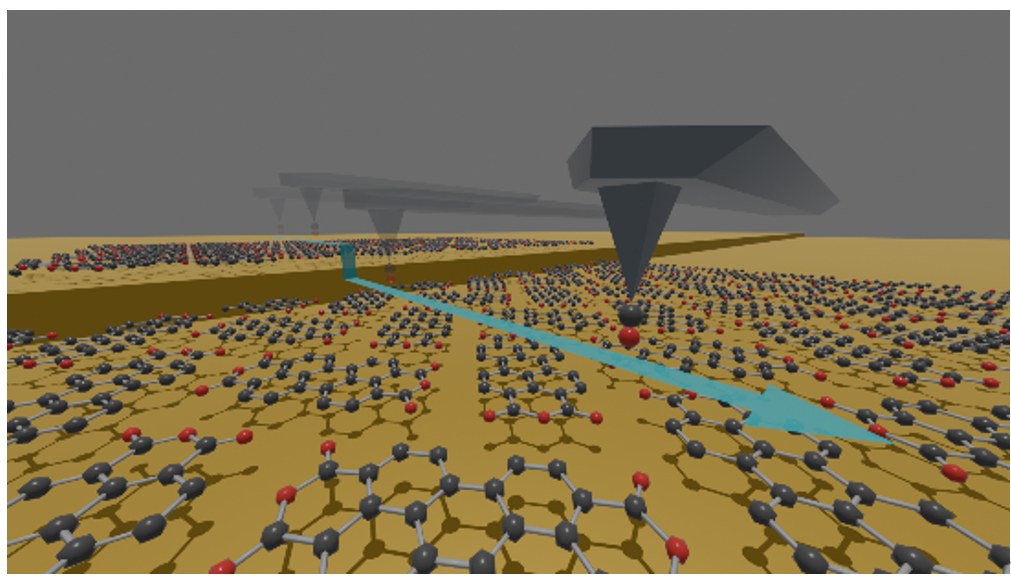
分子膜の高低差に追従する新世代の顕微鏡
<関連情報>
- https://www.k.u-tokyo.ac.jp/information/category/press/0030321.html
- https://journals.aps.org/prl/abstract/10.1103/y4xr-dvwt
力感度の向上により化学構造イメージングの速度限界を突破 Breaking the Speed Limit of Chemical-Structure Imaging with Enhanced Force Sensitivity
Yuuki Yasui and Yoshiaki Sugimoto
Physical Review Letters Published: 23 July, 2026
DOI: https://doi.org/10.1103/y4xr-dvwt
Abstract
Atomic force microscopy (AFM) with a functionalized tip can resolve the chemical structure of single molecules, but its application has been limited by slow imaging speeds and the restriction to constant-height operation. Here, we overcome these limitations by operating a Si cantilever in its second resonance mode, achieving exceptional force sensitivity. This enables robust, constant-height chemical-structure imaging at speeds up to 200 nm/s—over 60 times faster than previously reported. The enhanced sensitivity also resolves molecular bonds directly in constant-frequency-shift topographic images, a mode crucial for studying nonplanar systems. Our approach significantly expands the capabilities of AFM, opening new avenues for investigating the structure of three-dimensional molecules and tracking the dynamics of on-surface chemical reactions.