2026-07-17 東京科学大学
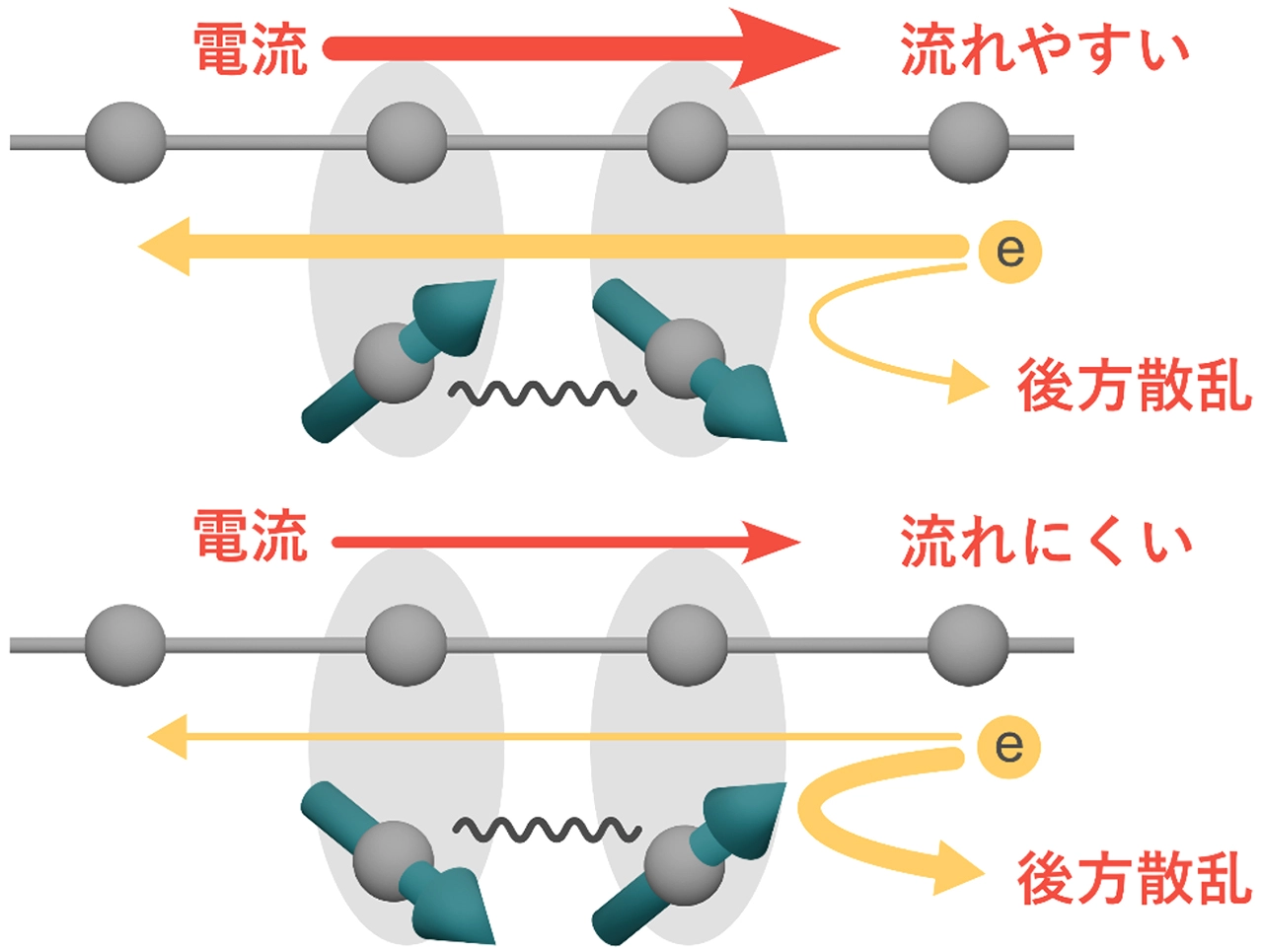
図1. ベクトル・カイラリティを持つ2スピン(各図の青で示したスピン)による非対称磁気散乱の模式図。
<関連情報>
非相互応答における近藤効果 Kondo Effect in Nonreciprocal Response
Hajime Murata and Hiroaki Ishizuka
Physical Review Letters Published: 15 July, 2026
DOI: https://doi.org/10.1103/y243-ygbf
Abstract
Chiral magnetic states give rise to rich phenomena, from the anomalous Hall effect and the nonlinear electrical current to multiferroics and magnetochiral dichroism. Most of the studies on electrical transport so far have focused on the cases where the magnetic moments are well approximated by classical local moments. Here, we reveal that the coexistence of quantum fluctuations and chiral spin correlations gives rise to a log(T) temperature dependence in the electrical magnetochiral effect, a nonreciprocal response. Using the Green’s function method and a scattering theory approach, we show that the log(T) temperature dependence occurs through a scattering process similar to that of the Kondo effect. The electrical magnetochiral effect is sensitive to the sign of vector spin chirality and the magnetic field. The results demonstrate that local spin correlations and quantum fluctuations cooperatively induce nontrivial properties in transport phenomena.