2026-07-14 中国科学院(CAS)
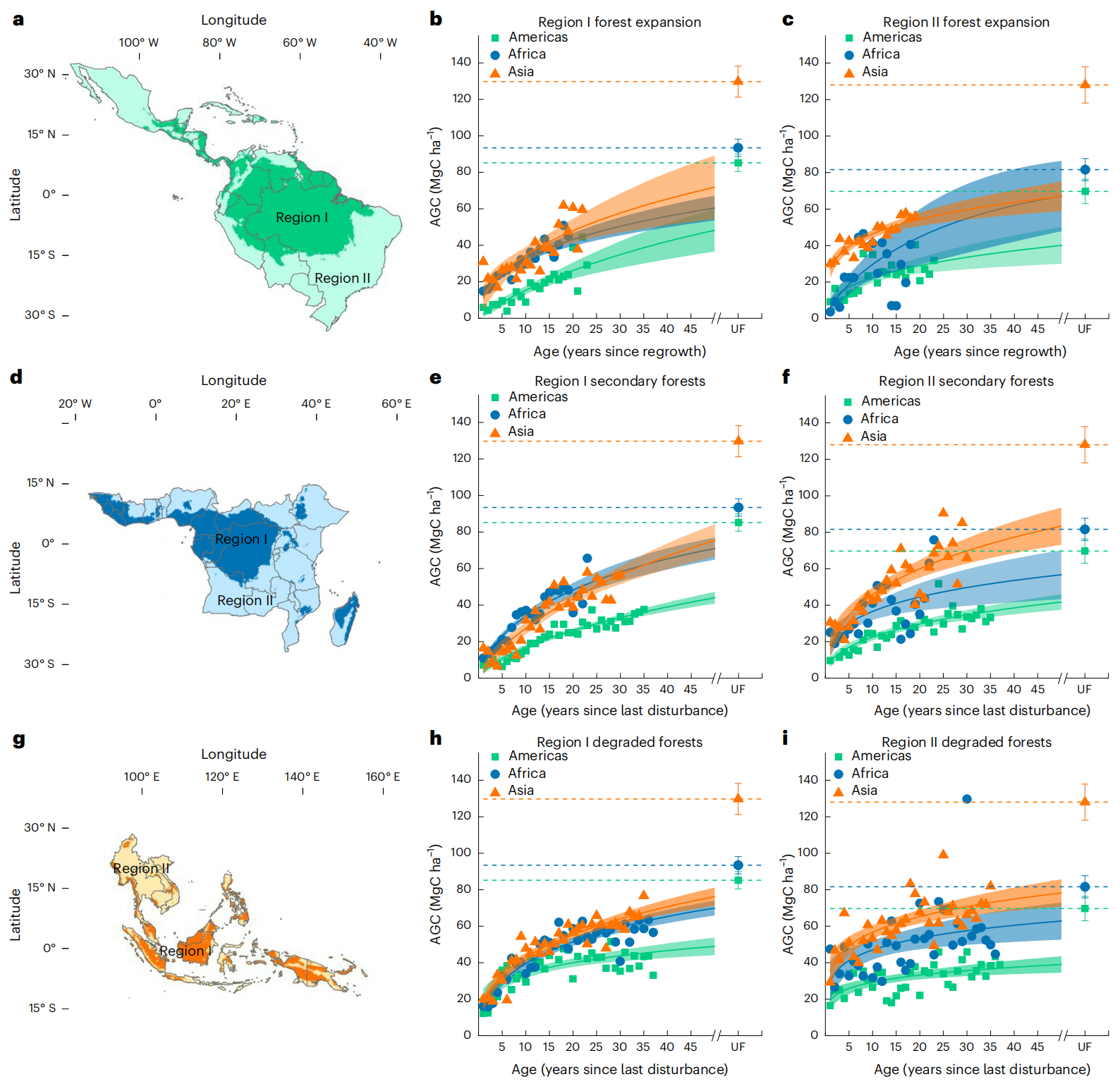
Modeled region-specific AGC accumulation for naturally regenerating forests. Climatic Regions I and II for the tropical Americas (a), Africa (d) and Asia (g). Modeled AGC accumulation curves for natural forest expansion (b, c), secondary forest (e, f) and degraded forest (h, i) in Regions I and II across the three tropical regions. (Image by APM)
<関連情報>
- https://english.cas.cn/newsroom/research-news/202607/t20260715_1178417.shtml
- https://www.nature.com/articles/s41561-026-01984-5
湿潤熱帯地域では、自然林の拡大は二次林よりも大きな炭素吸収源となる Natural forest expansion is a larger carbon sink than secondary forests in moist tropics
Yihang Zhang,Viola H. A. Heinrich,Clément Bourgoin,Xia Wang,Xiaodong Li,Yun Du & Peter M. Atkinson
Nature Geoscience Published:04 June 2026
DOI:https://doi.org/10.1038/s41561-026-01984-5
Abstract
Tropical secondary forests grow back naturally after the original forest has been cleared, while degraded forests comprise regrowth within forested land that has experienced partial structural and functional loss. Both represent important carbon sinks. However, natural forest expansion into originally unforested land also occurs, and despite covering 6% more area than secondary forests in the moist tropics, its carbon sink remains unquantified. Here we quantify the above-ground carbon sink and analyse its drivers across natural forest expansion, secondary forest and degraded forest by combining satellite-derived tropical moist forest changes with spaceborne LiDAR-derived biomass. The above-ground carbon accumulation of natural forest expansion is comparable to that of secondary forests, particularly in the Americas, but shows greater sensitivity to climatic and environmental variations. Natural forest expansion sequesters 5.4% more above-ground carbon (795 ± 132 TgC) than secondary forests (754 ± 105 TgC). It offsets an additional 2.4 ± 0.6% of the carbon emissions from deforestation and degradation of old-growth forests, while regrowth in secondary and degraded forests offsets 2.3 ± 0.5% and 13.6 ± 2.1%, respectively. Our results highlight natural forest expansion as an overlooked pan-tropical carbon sink with great mitigation potential, if invested in sustainably, alongside the protection of old-growth and regenerating forests.