2026-07-15 中国科学院(CAS)
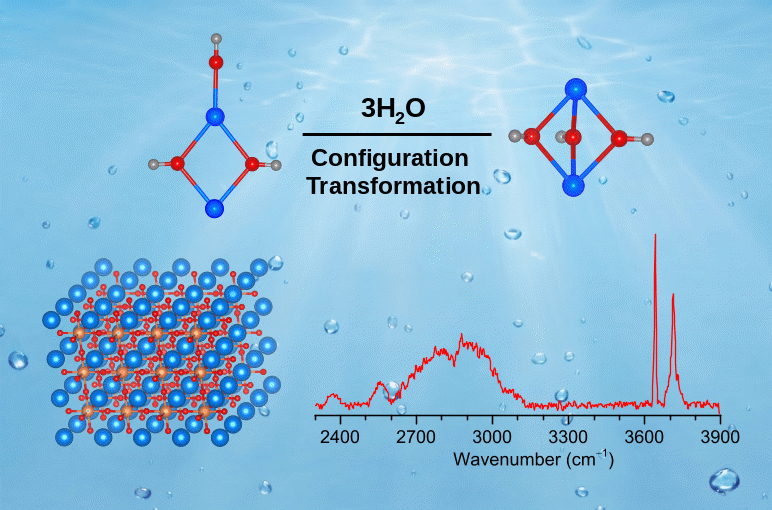
Experimental IR spectra via the 193 nm vacuum ultraviolet laser, identified structures of neutral Sr2(OH)3(H2O)3 clusters, and a Sr-based perovskite model. (Image by JIANG Shuai)
<関連情報>
- https://english.cas.cn/newsroom/research-news/202607/t20260715_1178462.shtml
- https://www.chinesechemsoc.org/doi/10.31635/ccschem.026.202608054
中性ジストロンチウム水酸化物の赤外分光法により、成長する水クラスターにおける構造変化が解明される
Infrared Spectroscopy of Neutral Distrontium Hydroxides Unravels Configuration Transformation in Growing Water Clusters
Shuai Jiang,Shangdong Li,Wenhui Yan,Jianxing Zhuang,Ailin Wang,Shiying Jiang,Yue Zhu,Hongwei Li,Hua Xie,Chuanfan Ding,Gang Li,Yinghua Yan, …
CCS Chemistry Published:2 Jul 2026
DOI:https://doi.org/10.31635/ccschem.026.202608054
Elucidating the hydration dynamics of polynuclear metals is vital for understanding the fundamental physicochemical properties of various interfacial processes. Nevertheless, the structural characterization of these neutral complexes is hindered by the inherent difficulties associated with experimental size selection. Here, the microhydration pathways and structural transformations of neutral Sr2(OH)3(H2O)n (n = 1–5) clusters were unveiled through size-selected infrared-vacuum ultraviolet spectroscopy, coupled with quantum chemical calculations as well as ab initio molecular dynamics simulations. The results reveal that three water molecules are sufficient to trigger the configuration transformation from Sr2(μ2-OH)2(η1-OH) to Sr2(μ2-OH)3. This intriguing transition is found to be driven by hydration-induced structural deformation, achieving thermodynamic stability through the rearrangement of the hydrogen-bonding network. The current system affords a model for clarifying the metal-oxygen skeleton and hydration dynamics in the microenvironment of perovskite catalysts and opens new avenues for systematic understanding of hydration-driven lattice rearrangements, active site modulation, and catalyst activation.