2026-07-16 岡山大学,北海道大学
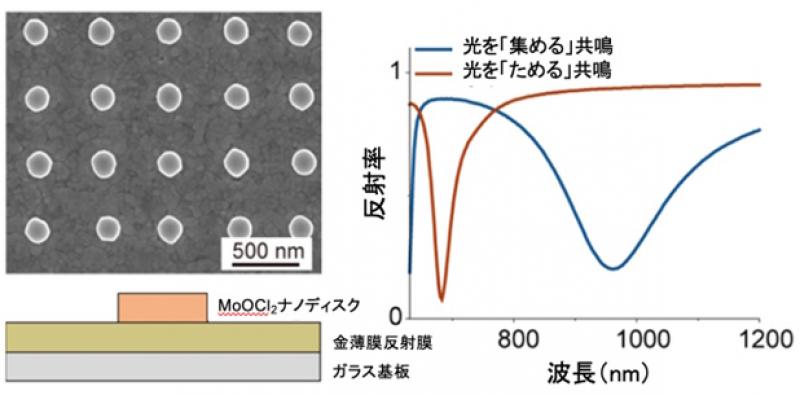
図1 一つのMoOCl2ナノ構造で実現した二つの光の働き
<関連情報>
- https://www.okayama-u.ac.jp/tp/release/release_id1568.html
- https://pubs.acs.org/doi/10.1021/acsnano.6c06696
双曲型材料の単一ナノ構造における金属共鳴モードと誘電体共鳴モードの共存 Coexistence of Metal and Dielectric Resonance Modes in a Single Nanostructure of a Hyperbolic Material
Yaolong LiXu Shi,Yuxin Zhang,Yen-En Liu,Lin Qiao,Hong Yang,Shufeng Wang,Guowei Lyu,Yasutaka Matsuo,Xiaoyong Hu,Qihuang Gong,and Hiroaki Misawa
ACS Nano Published: June 20, 2026
DOI:https://doi.org/10.1021/acsnano.6c06696
Abstract
Hyperbolic materials that exhibit metal and dielectric responses to orthogonal polarizations offer possibilities for controlling nanophotonic modes beyond those of conventional isotropic materials. Here, we demonstrate the coexistence of metal and dielectric resonance modes in single MoOCl2 nanostructures, a hyperbolic plasmon material with metal-dielectric duality. The two modes are nonhybrid and are controlled independently by the two orthogonal in-plane polarizations, without mode mixing or crosstalk. According to mode analysis, localized plasmon resonance is excited along the metal permittivity axis of MoOCl2, while the dielectric magnetic dipole mode is excited along the orthogonal dielectric axis. Compared to the plasmonic mode, the dielectric mode has a much higher Q factor and a different hotspot distribution. The dielectric mode also exhibits much stronger photoemission enhancement due to the different hotspot distribution along the z-axis, as measured by photoemission electron microscopy. By adjusting the structural parameters, the two modes can be tuned to overlap in spectra while maintaining the polarization control. The coexistence of these modes and their polarization dependence in single nanostructures provide a fundamental strategy for nanophotonic design, particularly for engineering polarizations, enhancing nonlinear processes, and achieving multifunctional metasurfaces.