2026-07-09 神戸大学
<関連情報>
- https://www.kobe-u.ac.jp/ja/news/article/20260709-68106/
- https://pubs.acs.org/doi/10.1021/acscatal.6c03613
ニトリルを選択的に水素化して第二級アミンを生成するための、高効率かつ安定なNi-Wナノ合金触媒 Highly Efficient and Stable Ni–W Nanoalloy Catalyst for Selective Hydrogenation of Nitriles to Secondary Amines
Taiki KawakamiYuxuan Feng,Kentaro Okano,and Sho Yamaguch
ACS Catalysis Published: July 7, 2026
DOI:https://doi.org/10.1021/acscatal.6c03613
Abstract
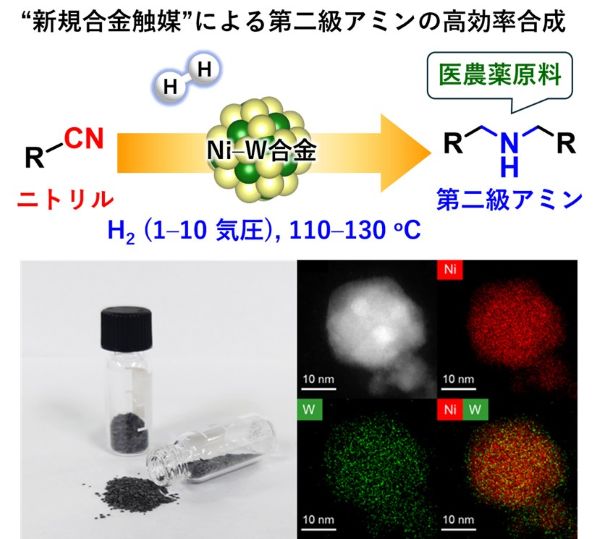
Alloying with other metals is an effective strategy for enhancing the catalytic performance of intrinsically low-activity, non-precious metals. Liquid-phase reduction is a powerful method for synthesizing well-defined metal alloy nanoparticles with narrow size distributions and controlled structures; however, combining non-precious metals with early-transition metals remains largely unexplored due to their significantly different chemical properties. Herein, we report the development of a well-defined Ni–W nanoalloy (nano-NiW) by using a liquid-phase reduction method and its application as a heterogeneous catalyst for the hydrogenation of nitriles to secondary amines. The nano-NiW catalyst exhibited higher activity compared with monometallic Ni and conventionally impregnated Ni–W catalysts, enabling the selective nitrile hydrogenation to secondary amines even at 0.1 MPa H2. The catalyst also showed a broad substrate scope and could be recycled without loss of activity. Comprehensive structural and kinetic analyses revealed that incorporation of W into nano-NiW facilitates Schiff base reduction, a key step in the catalytic cycle. Overall, this study substantially advances the performance of Ni-based catalysts and offers a promising strategy for more efficient and economical organic synthesis.