2026-07-08 中国科学院(CAS)
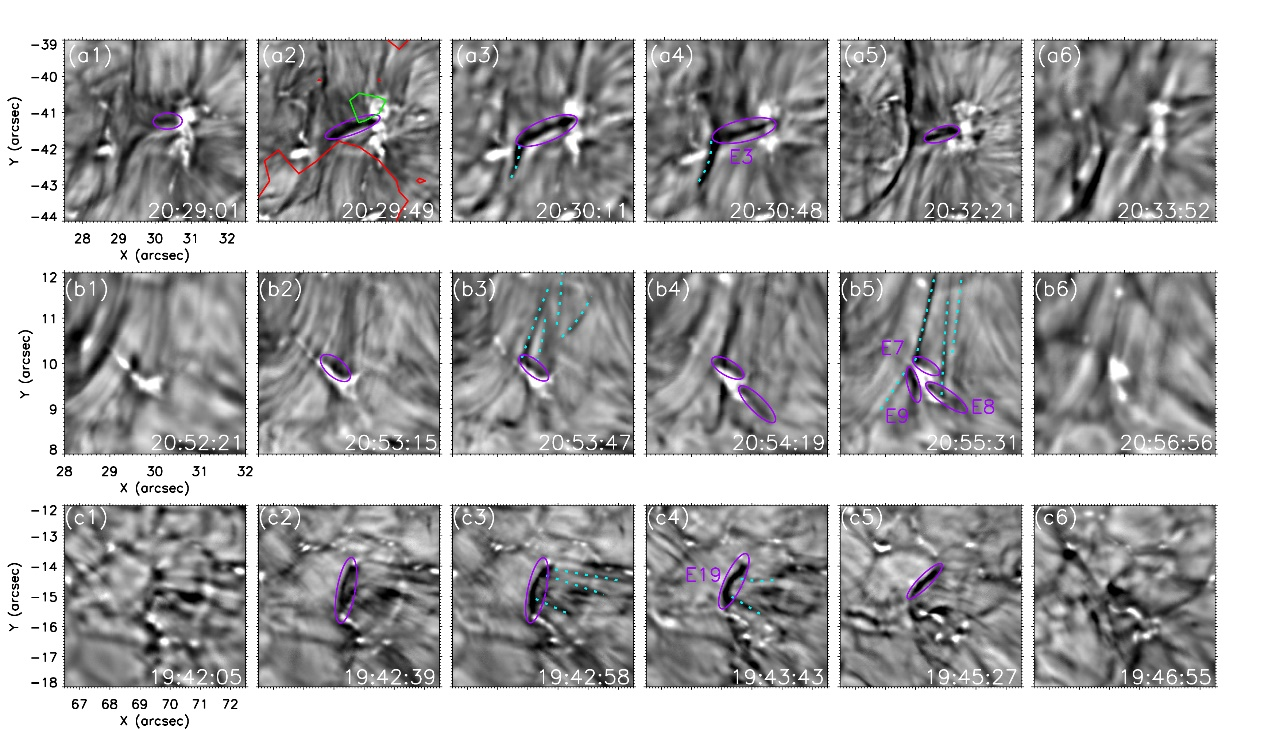
Evolution of five microfilament eruptions. The locations of the microfilaments are marked by purple ellipses, and the spicules produced by the eruptions are denoted by cyan dotted lines. In panel (a2), the red contour represents +12 G and the green contour represents −12 G. (Image by DONG Qifan)
<関連情報>
- https://english.cas.cn/newsroom/research-news/202607/t20260708_1176874.shtml
- https://iopscience.iop.org/article/10.3847/2041-8213/ae80be
DKISTを用いたマイクロフィラメント噴火に伴う太陽スピキュールの観測的証拠 Observational Evidence of Solar Spicules Associated with Microfilament Eruptions Using DKIST
Qifan Dong, Xiaoli Yan, Zhike Xue, Liheng Yang, Jincheng Wang, Yadan Duan, Zhe Xu, Yian Zhou, Xinsheng Zhang, Zongyin Wu,…
The Astrophysical Journal Letters Published: 2026 July 6
DOI:10.3847/2041-8213/ae80be
Abstract
The formation mechanism of spicules is fundamentally important for understanding mass and energy transport from the chromosphere into the corona. Recent studies suggested that spicules may be powered by microfilament eruptions. However, direct observational evidence remains limited due to insufficient spatial resolution. Using high-resolution Hα broadband observations from the Visible Broadband Imager on board the Daniel K. Inouye Solar Telescope, we identify 30 spicule events triggered by microfilament eruptions in a quiet-Sun region near the solar disk center on 2023 August 29. The detected microfilaments have an average length of 0.93 ± 0.46 Mm and a minimum length of 0.17 Mm, substantially smaller than previously reported minifilaments. We identify two distinct morphological classes of ejecta: individual spicules associated with smaller microfilaments and enhanced spicular activities associated with larger microfilaments. Moreover, some events exhibit apparent twisting motions. All these high-resolution observations provide compelling evidence that spicules can be triggered by microfilament eruptions.