2026-07-03 中国科学院(CAS)
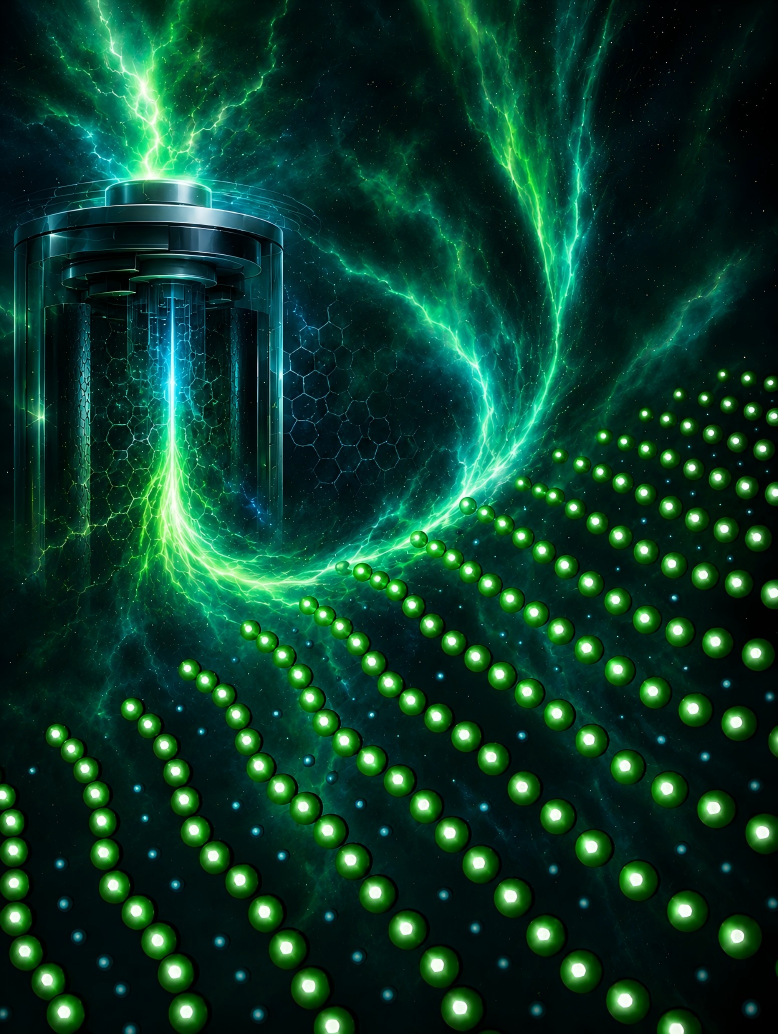
Schematic illustration of the atomistic failure mechanism of LiCoO2 under extreme high-voltage operation. (Image by IMR)
<関連情報>
- https://english.cas.cn/newsroom/research-news/202607/t20260702_1175220.shtml
- https://pubs.acs.org/doi/10.1021/jacs.6c04958
LiCoO₂正極における超高電圧故障の原子レベルでの起源 Atomic Origins of Ultrahigh-Voltage Failure in LiCoO2 Cathodes
Xulin Mu,Yutao Niu,Chenhao Zhang,Xinghua Tan,Hong Li,Feng Li,Chunyang Wang
Journal of the American Chemical Society Published: June 21, 2026
Abstract
Pushing lithium cobalt oxide (LCoO2) toward extremely high-voltage operation up to 5V is critical to boosting a battery’s energy density for future compact electronics. However, its degradation mechanisms at such extreme voltages remain unexplored. Here, we employ machine-learning-aided super-resolution electron microscopy to directly visualize, at atomic resolution, how LCoO2 structurally deteriorates under 5 V for the first time. We discover that deep delithiation activates global deformation in which in-plane shear breaks the O3 lattice into nanoscale mosaics of O1 and reoriented O3 domains, while out-of-plane distortions drive cracking and kinetically trapped structural motifs. Upon extended cycling, these coupled chemomechanical processes evolve into a frustrated surface architecture comprising intertwined misoriented domains and antiphase boundaries. Building on these mechanistic insights, we deliver a proof-of-concept demonstration that rationally designed codoping provides a targeted route to mitigate the coupled deformation and phase-degradation cascade, markedly pushing the cycling stability of LiCoO2 toward unprecedented ultrahigh voltage. Our work establishes a new paradigm for materials optimization by leveraging atomic-scale diagnostics to mitigate degradation at its origin.