2026-07-02 ペンシルベニア州立大学(Penn State)
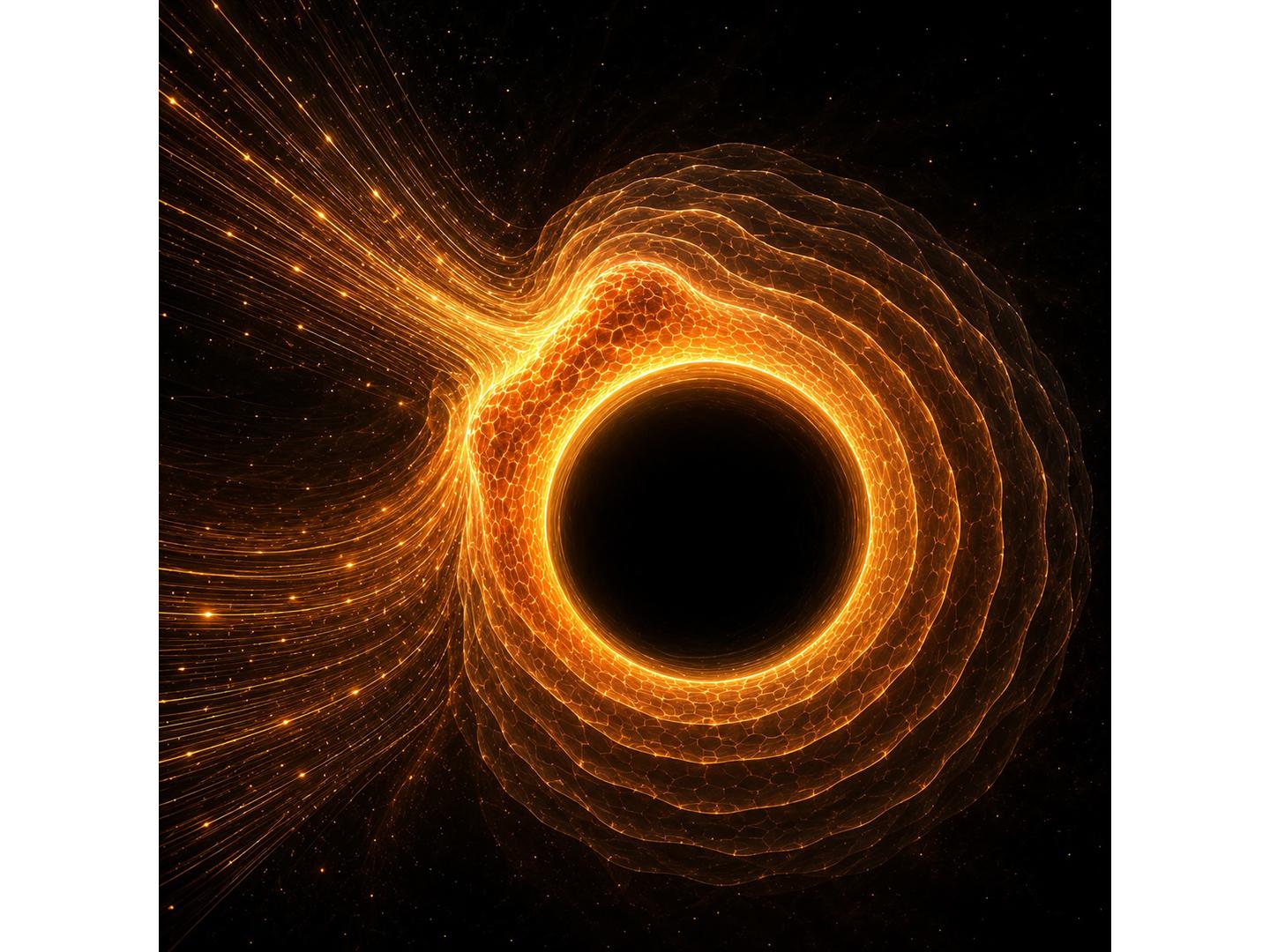
Illustration of a black hole that is growing in response to an influx of energy.
Credit: Jonathan Shu and Daniel Paraizo / Penn State. Creative Commons
<関連情報>
- https://www.psu.edu/news/eberly-college-science/story/dynamic-black-holes-explained-simple-thermodynamics
- https://journals.aps.org/prl/abstract/10.1103/3c1r-v8f1
ブラックホールの熱力学:平衡状態から遠く離れた場合 Thermodynamics of Black Holes, Far from Equilibrium
Abhay Ashtekar, Daniel E. Paraizo, and Jonathan Shu
Physical Review Letters Published :24 June, 2026
DOI: https://doi.org/10.1103/3c1r-v8f1
Abstract
As in thermodynamics, the celebrated first law of black hole mechanics relates infinitesimal changes in the properties of nearby equilibrium states of black holes (without reference to any physical process that causes the transition). Using dynamical horizon segments (DHSs), we extend the first law to encompass black holes that can be arbitrarily far from equilibrium. It now refers to finite changes that occur due to physical processes. This extension, together with the generalized second law on DHSs [A. Ashtekar and B. Krishnan, Dynamical horizons and their properties, Phys. Rev. D 68, 104030 (2003)], naturally lead one to identify entropy of dynamical black holes with the area of DHSs.