2026-07-01 中国科学院(CAS)
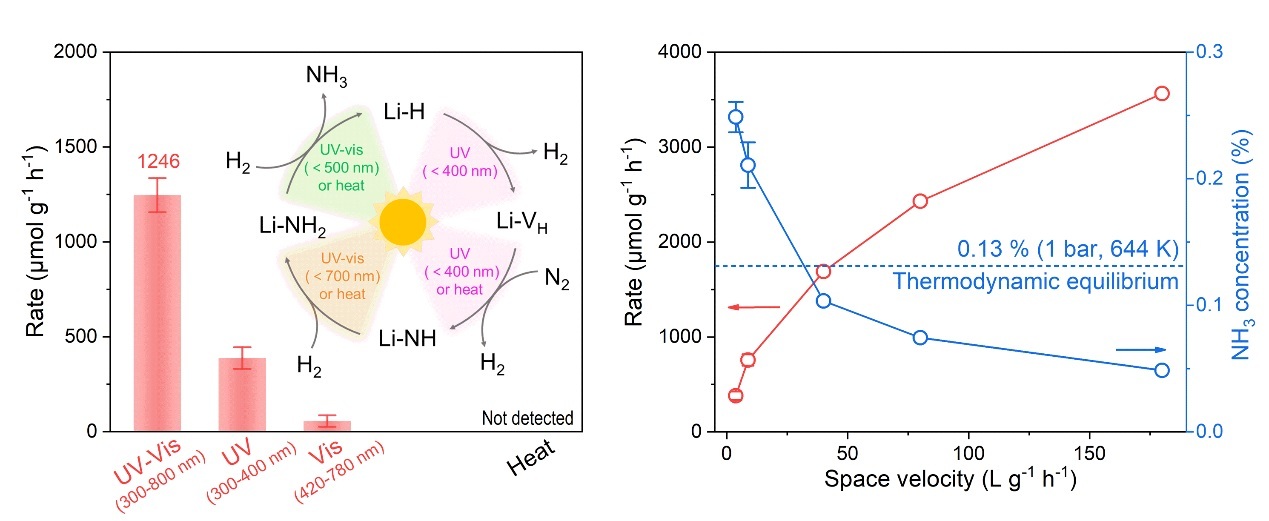
Catalytic performance and mechanism of photo-driven ammonia synthesis process mediated by LiH. (Image by GUAN Yeqin)
<関連情報>
- https://english.cas.cn/newsroom/research-news/202607/t20260701_1175175.shtml
- https://pubs.acs.org/doi/10.1021/jacs.6c04222
リチウム水素化物触媒を用いた波長依存性窒素固定およびアンモニアへの水素化 Wavelength-Dependent Nitrogen Fixation and Hydrogenation to Ammonia over Lithium Hydride Catalyst
Yeqin Guan,Zhaoji Huang,Kai Ma,Xiangdong Zeng,Kaixun Cui,Peng Zhang,Zibo Cheng,Muyao Liu,Junwang Tang,Anan Wu,Jianping Guo,and Ping Chen
Journal of the American Chemical Society Published: May 14, 2026
DOI:https://doi.org/10.1021/jacs.6c04222
Abstract
Photocatalytic nitrogen (N2) reduction offers a renewable route for mild-condition ammonia (NH3) synthesis and has garnered increasing attention. Most efforts have focused on tailoring the band structures of photocatalysts, yet the photon-responsive behavior of key reactive intermediates (such as NH and NH2) that could have a strong impact on the energetics of individual steps has remained essentially uninvestigated primarily due to their low abundance and high lability. Herein, we report a transition-metal-free lithium hydride (LiH) catalyst that forms detectable lithium hydride with hydrogen vacancies (LiH1–x), lithium imide (Li2NH), and lithium amide (LiNH2) intermediate states during NH3 formation and therefore exhibits dynamic photoresponsive behaviors. This catalyst provides an ideal platform to investigate the wavelength-tailored regulation of intermediates in this bellwether reaction of catalysis. Specifically, ultraviolet light activates LiH for N2 reduction, forming LiH1–x, Li2NH, and LiNH2 species. Those species/states can absorb ultraviolet and visible light, enabling efficient H2 dissociation and sequential hydrogenation to produce NH3. In this unique scenario, the reaction energetics of individual steps are wavelength dependent, thus decoupling the scaling relations that constrain thermal catalysis. Such a cumulative photon effect on the catalyst and reactive species leads to a prominent NH3 concentration of ca. 0.25%, exceeding the thermodynamic limit of 0.13% at 644 K and atmospheric pressure.