
2026-06-25 パシフィック・ノースウェスト国立研究所(PNNL)
<関連情報>
- https://www.pnnl.gov/publications/carbenium-ion-dynamics-lewis-acid-catalyzed-isopentane-disproportionation
- https://pubs.acs.org/doi/10.1021/jacs.6c03060
ルイス酸性クロロアルミン酸イオン液体中におけるイソペンタンの不均化反応 Isopentane Disproportionation in Lewis Acidic Chloroaluminate Ionic Liquid
Jiande Mai,David E. Ryan,Wei Zhang,Benjamin A. Jackson,Kiyoung Jo,Janos Szanyi,Oliver Y. Gutiérrez,Honghong Shi,Donald M. Camaioni,Rachit Khare,Mal-Soon Lee,Huamin Wang,Sungmin Kim,and Johannes A. Lercher
Journal of the American Chemical Society Published: June 17, 2026
DOI:https://doi.org/10.1021/jacs.6c03060
Abstract
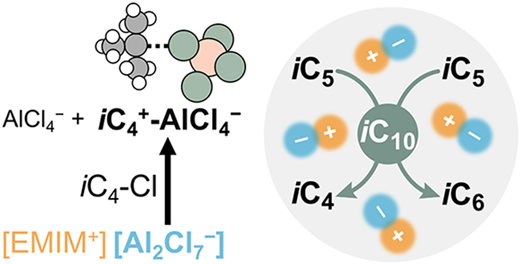
Lewis acidic chloroaluminate ionic liquid diluted in dichloromethane catalyzes the disproportionation of alkanes, such as isopentane, via carbenium ions in a reaction readily initiated by carbenium ion precursors such as tert-butyl chloride (TBC). The carbenium ion-AlCl4– ion-pairs stabilized by the ionic liquid-dichloromethane solution are the key intermediates in two distinctive kinetic regimes, i.e., a transient regime (0–5 min) and a steady-state regime (after 5 min). The transient regime constitutes the majority of isopentane conversion and is governed by the initial carbenium ion concentration. In the steady-state regime, disproportionation occurs at a considerably lower rate, affected by the carbenium ion concentration, the concentration of the ionic liquid, and the reaction temperature. The formation of alkenes observed in the 1H NMR spectra of the reacting substrates, along with the DFT calculations, suggests that deprotonation of carbenium ion-pairs reduces their concentration, decreasing, in turn, the reaction rate. Kinetic modeling indicates that the transient regime is significantly controlled by the hydride transfer (kHT) and the deprotonation rate constants (kDP), while the steady-state regime is additionally influenced by the alkene protonation rate constant (k–DP). The overall activation energy of the reaction at the steady state, expressed as Ea,steady-state regime = Ea,HT – Ea,DP + Ea,–DP, was 54 kJ/mol. The reaction mechanism and the kinetics highlight the potential of Lewis acid-catalyzed conversions of hydrocarbons under remarkably mild conditions.

