2026-06-25 パシフィック・ノースウェスト国立研究所(PNNL)
<関連情報>
- https://www.pnnl.gov/news-media/agentic-ai-bot-helps-scientists-speak-robots-speed-experiments
- https://www.nature.com/articles/s41598-026-45593-z
AutoLabs:自律的な化学実験のための自己修正機能を備えた認知型マルチエージェントシステム AutoLabs: cognitive multi-agent systems with self-correction for autonomous chemical experimentation
Gihan Panapitiya,Emily Saldanha,Heather Job & Olivia Hess
Scientific Reports Published:25 June 2026
DOI:https://doi.org/10.1038/s41598-026-45593-z
Abstract
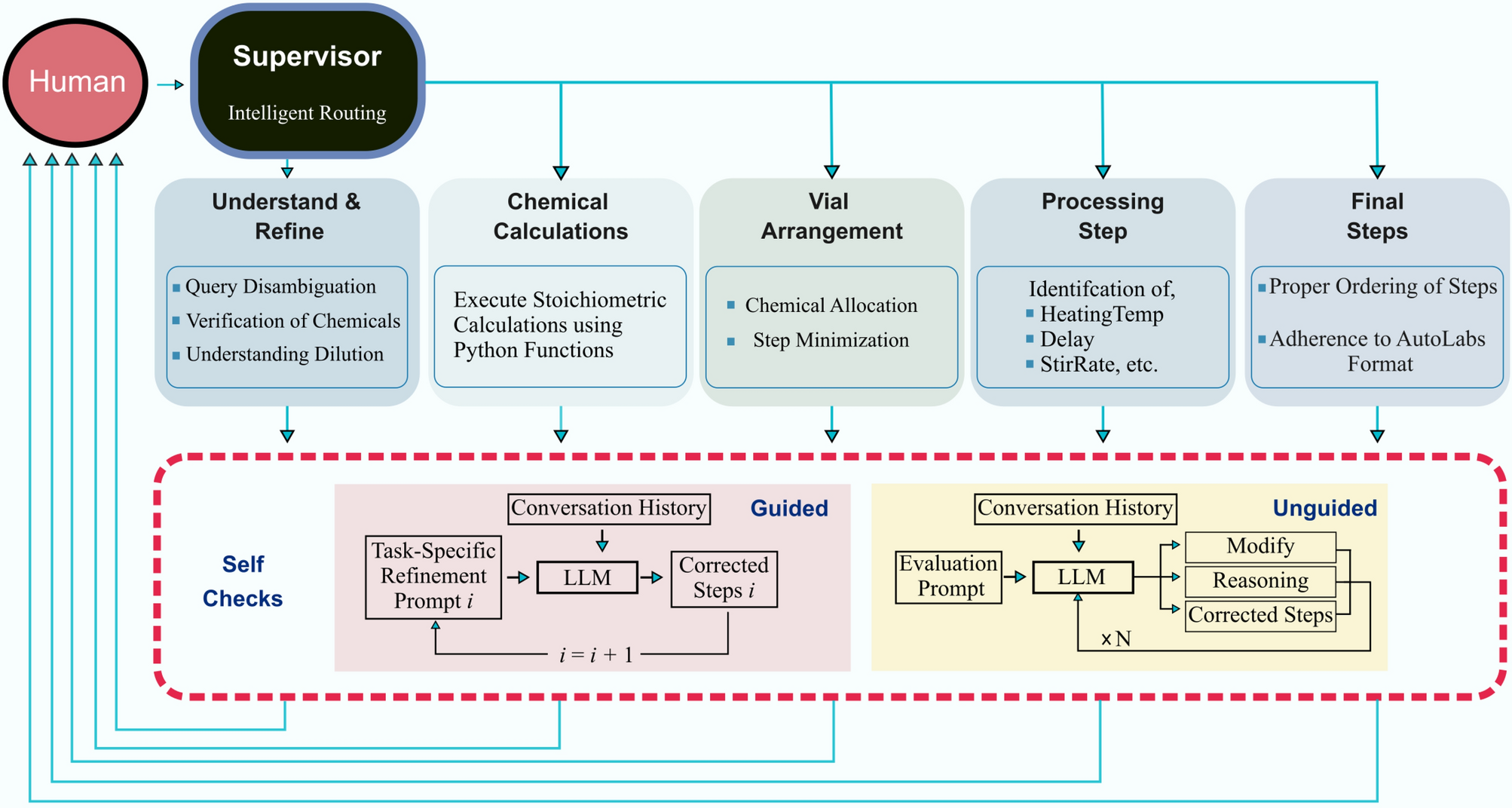
The automation of chemical research through self-driving laboratories (SDLs) promises to accelerate scientific discovery, yet the reliability and granular performance of the underlying AI agents remain critical, under-examined challenges. In this work, we introduce AutoLabs, a self-correcting, multi-agent architecture designed to autonomously translate natural-language instructions into executable protocols for a high-throughput liquid handler. The system engages users in dialogue, decomposes experimental goals into discrete tasks for specialized agents, performs tool-assisted stoichiometric calculations, and iteratively self-corrects its output before generating a hardware-ready file. We present a comprehensive evaluation framework featuring five benchmark experiments of increasing complexity, from simple sample preparation to multi-plate timed syntheses. Through a systematic ablation study of 20 agent configurations, we assess the impact of reasoning capacity, architectural design (single- vs. multi-agent), tool use, and self-correction mechanisms. Our results demonstrate that agent reasoning capacity is the most critical factor for success, reducing quantitative errors in chemical amounts (nRMSE) by over 85% in complex tasks. When combined with a multi-agent architecture and iterative self-correction, AutoLabs approaches expert-authored reference procedures on the benchmark (F1-score > 0.89) on challenging multi-plate syntheses. These findings establish a clear blueprint for developing robust and trustworthy AI partners for autonomous laboratories, highlighting the synergistic effects of modular design, advanced reasoning, and self-correction to ensure both performance and reliability in high-stakes scientific applications. Code: https://github.com/pnnl/autolabs