2026-06-24 合肥物質科学研究院(HFIPS)
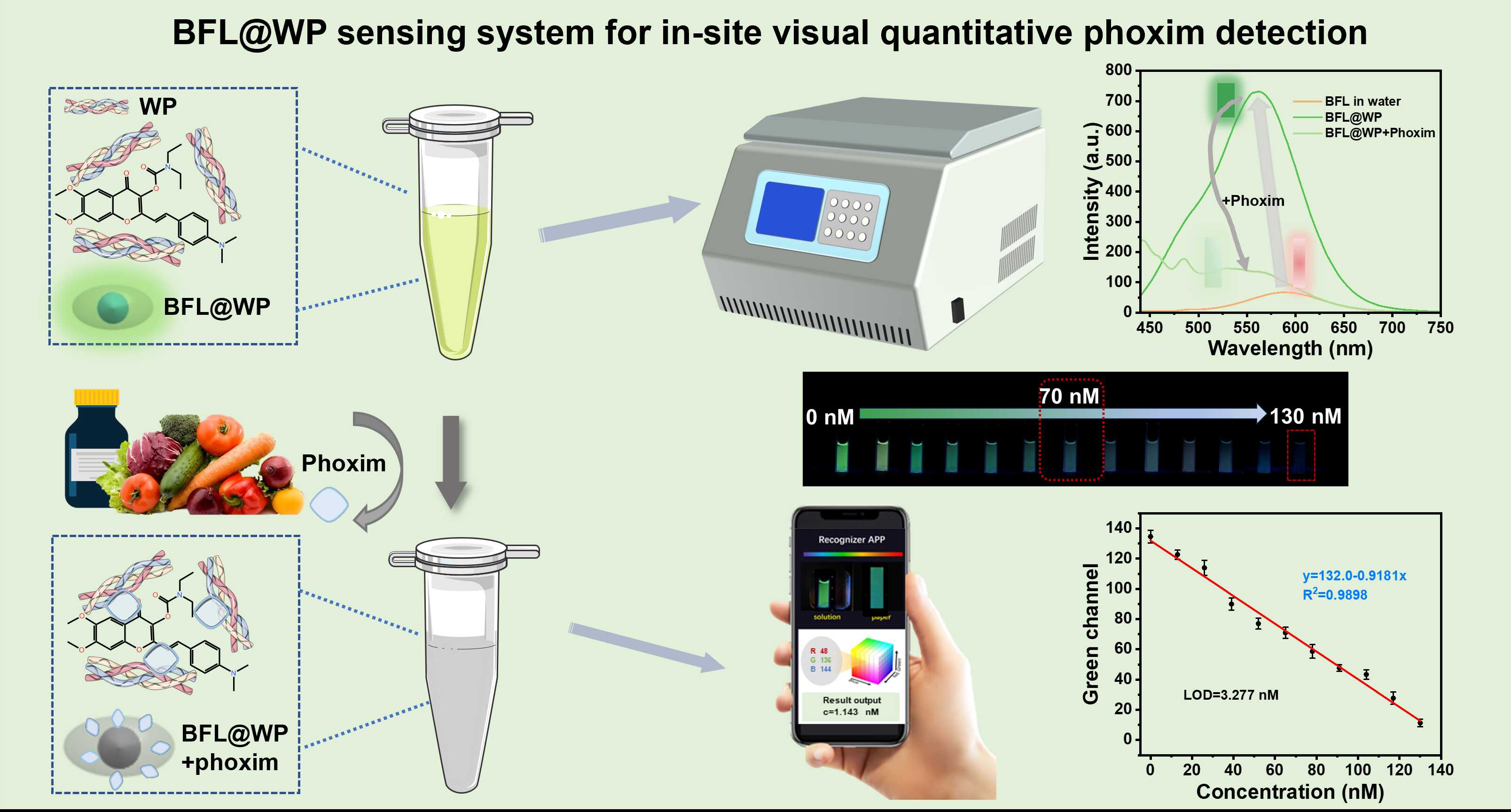
Detection of phoxim based on the BFL@WP supramolecular sensing system. (Image by LIU Anqi)
<関連情報>
- https://english.hf.cas.cn/nr/rn/202606/t20260624_1174549.html
- https://pubs.acs.org/doi/10.1021/acs.analchem.6c01482
フラボノイド系蛍光色素@ホエイプロテインセンサーにおける競合結合によるフォキシムの迅速な視覚的検出 Rapid Visual Detection of Phoxim Via Competitive Binding in a Flavonoid-Based Fluorescent Dye@Whey Protein Sensor
Anqi Liu,Mengmeng Li,Kongwen Zhu,Ruoxuan Jiang,Xin Song,Dan Lin,and Changlong Jiang
Analytical Chemistry Published: May 15, 2026
DOI:https://doi.org/10.1021/acs.analchem.6c01482
Abstract
The health risks and public safety issues associated with pesticide residues have long been a subject of sustained concern. In particular, the detection of highly toxic phoxim has remained key focus in the development of rapid sensing technologies. In this work, we constructed a D–A dye@whey protein (WP) sensing system specifically tailored for phoxim detection. Unlike previous systems relying on inorganic fluorescent nanomaterials, we designed and synthesized a donor–acceptor (D–A) dye as the fluorescence signal output unit, while whey protein was employed as the specific recognition unit, modified onto the dye molecules to form the complete sensing platform. The stronger interaction between phoxim and specific amino acid residues in whey protein induces changes in the microenvironment around the D–A dye, resulting in measurable fluorescence variations. As a result, the presence of phoxim can be visually assessed through fluorescence changes. By establishing a quantitative relationship between the fluorescence signal and pesticide concentration, detection can be performed quantitatively using a smartphone-based platform with the LOD low to 1.143 nM. Compared to earlier sensors, the present system exhibits high sensitivity, rapid response, and strong anti-interference capability. Leveraging the ease of structural modification of organic fluorescent dyes, together with the sensing mechanism based on microenvironment-induced fluorescence modulation of D–A dyes, this strategy paves the way for developing further sensors targeting trace hazardous substances for practical applications.