2026-06-24 中国科学院(CAS)
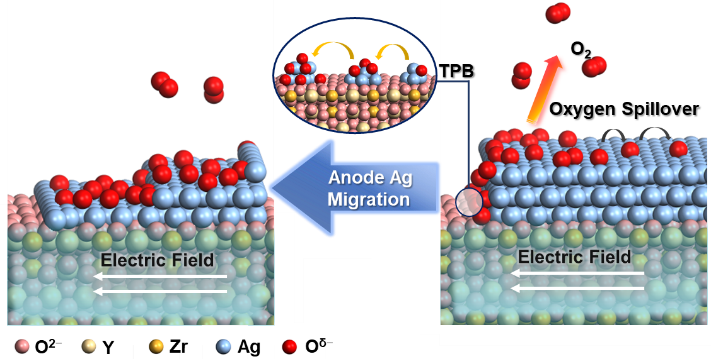
Schematic of Ag migration dynamics in the model SOECs governed by coupled electric field and oxygen spillover. (Image by PEI Jinhui)
<関連情報>
- https://english.cas.cn/newsroom/research-news/202606/t20260624_1174733.shtml
- https://pubs.acs.org/doi/10.1021/jacs.6c07436
固体酸化物電解セルにおける電極移動は、電場と酸素スピルオーバーのカップリングによって制御される Electric Field and Oxygen Spillover Coupling Governs Electrode Migration in Solid Oxide Electrolysis Cells
Jinhui Pei,Xiaoqin Chen,Yanxiao Ning,and Qiang Fu
Journal of the American Chemical Society Published: June 14, 2026
DOI:https://doi.org/10.1021/jacs.6c07436
Abstract
Dynamic restructuring of electrode surfaces and interfaces often occurs upon electrochemical polarization in solid oxide cells, yet fundamental understanding of such processes requires in situ characterization under operating potential and high temperature conditions. Herein, using a planar Ag|yttria-stabilized zirconia (YSZ)|Ag model cell, we apply near-ambient pressure photoemission electron microscopy (NAP-PEEM) and micro-region X-ray photoelectron spectroscopy (μ-XPS) to spatially resolve the dynamic evolution of the working Ag anode. PEEM directly visualizes oxygen spillover from the YSZ electrolyte onto the Ag surface, followed by long-range Ag migration extending over tens of micrometers. In situ control experiments confirm that the spilled-over oxygen drives Ag transport via the formation of mobile Ag–Oδ− species and the distribution of the electric field dictates the direction and speed of Ag migration. Furthermore, in situ mass spectrometry reveals that the dynamic restructuring of the Ag anode enhances the oxygen evolution reaction by generating more active triple-phase boundaries (TPBs). Collectively, our findings demonstrate that the electric field and oxygen spillover operate in a coupled manner to govern anode activation, providing crucial mechanistic insights for the rational design of interfaces in high-temperature electrochemical systems.