2026-05-26 中国科学院(CAS)
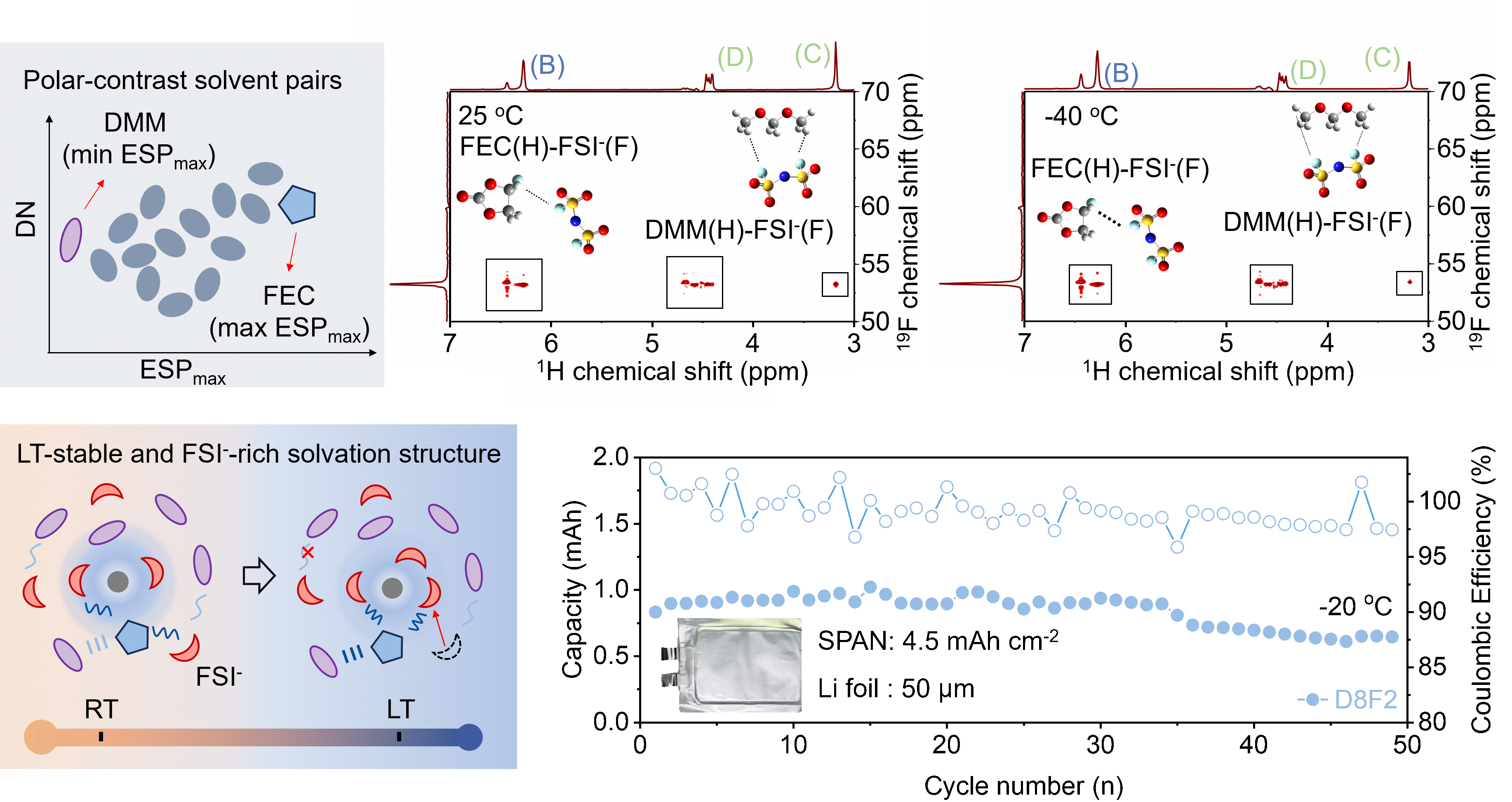
Polarity-contrast electrolyte for low-temperature lithium metal batteries (Image by REN Jingxuan, WANG Dongdong)
<関連情報>
- https://english.cas.cn/newsroom/research-news/202605/t20260527_1159979.shtml
- https://pubs.acs.org/doi/10.1021/jacs.6c03001
Anion Coordination Transition Enabled by Ion–Dipole Interactions At Low Temperatures
Jingxuan Ren,Dongdong Wang,Yufeng Chen,Renming Liu,Xinli Guo,Dan Luo,and Zhongwei Chen
Journal of the American Chemical Society Published: April 30, 2026
DOI:https://doi.org/10.1021/jacs.6c03001
Abstract
While constructing anion-involved solvation structures is key to improving electrolyte performance at low temperatures (LTs), conventional strategies that primarily manipulate Li+–solvent interactions present significant challenges. These include weakened anion coordination, impeded ion transport, and aggravated interfacial side reactions, making the realization of effective LT operation elusive. Here, we propose a “polarity-contrast” electrolyte design strategy, which enables the construction of a LT-stable, anion-rich solvation structure through deliberate regulation of anion–solvent interactions. The solvent pairs, dimethoxymethane (DMM) and fluoroethylene carbonate (FEC), which exhibits the lowest and highest maximum electrostatic potential, respectively, were selected for electrolyte engineering. At LTs, the weakened interactions between primary solvent DMM and FSI– promote the coordination of solvation of anions. Meanwhile, the coordinated FEC cosolvent enhances ion–dipole interactions with FSI–, further anchoring these anions within the solvation sheath. This FSI–-dominated solvation environment facilitates the formation of a fluorine-rich solid electrolyte interphase, which in turn enables uniform Li deposition under LT conditions. Therefore, Li||SPAN full cells demonstrate excellent LT performance, including a high areal capacity of 4.5 mAh cm–2 and 150 cycles with 80% retention at −40 °C. Notably, Ah-level Li||SPAN pouch cells demonstrate 50 cycles at −20 °C with exceptional capacity–temperature–lifespan balance, surpassing the most reported LT LMBs.